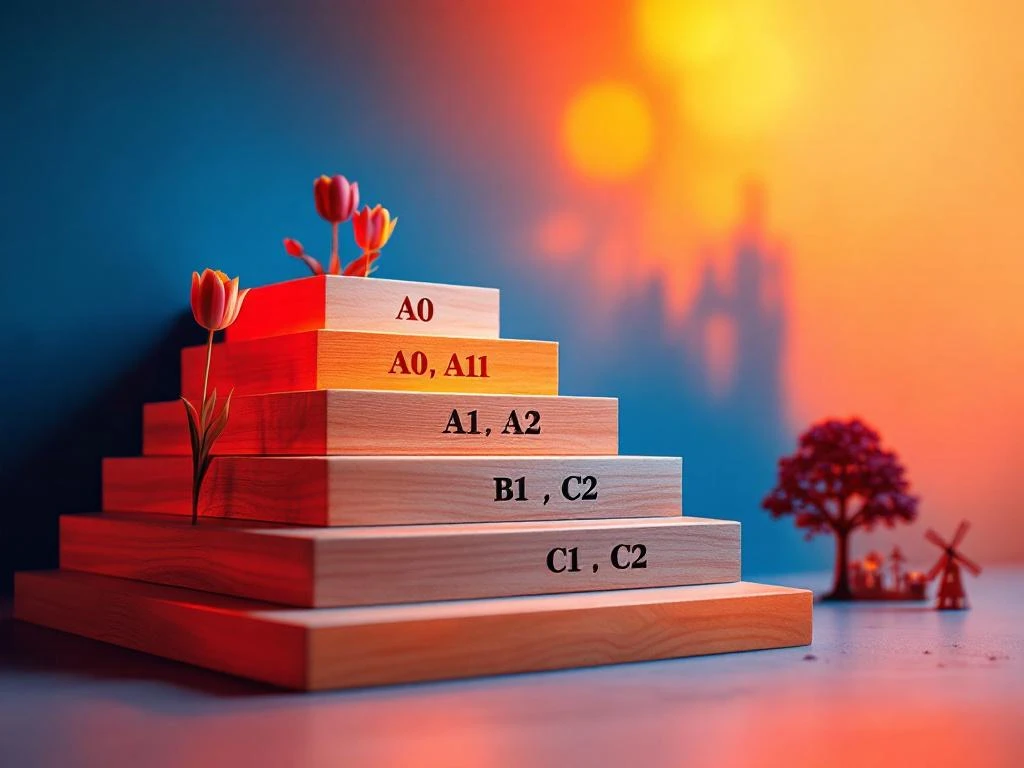
What levels are available in Dutch language courses?
Dutch language courses follow the Common European Framework of Reference for Languages (CEFR) levels. At Dutch on Track, we offer courses at three levels: A1, A2, and B1 — taking you from your very first words in Dutch to functional independence in everyday life. Each level builds on the previous one, developing your speaking, listening, reading, and writing skills through a structured, community-driven approach.
What do the Dutch language levels A1, A2, and B1 actually mean?
The CEFR levels provide a standardised way to measure Dutch proficiency. Dutch on Track offers three of these levels, each with clear goals and real-life applications that help you connect with Dutch society.
At A1 level, you’re starting from scratch or have only minimal Dutch knowledge. You’ll learn basic greetings, numbers, and simple phrases for everyday situations like shopping or introducing yourself. You can understand and use familiar expressions but need support in conversations. This is where you’ll make your first steps into Dutch culture and begin building connections with fellow learners from around the world.
At A2 level, you can handle simple interactions about familiar topics like family, work, and hobbies. You understand slow, clear speech and can write basic personal information on forms. Your vocabulary covers immediate needs and concrete situations, and you’ll start participating in cultural activities and understanding Dutch customs more naturally.
B1 level is where you achieve functional independence in Dutch. You can handle most travel situations, express opinions, describe experiences, and manage workplace communications. This level marks the transition from beginner to intermediate proficiency and opens opportunities for meaningful friendships with Dutch speakers and deeper cultural engagement. It is also the level required for the Dutch civic integration exam.
How long does it take to move from one Dutch level to the next?
Progressing between Dutch levels typically requires 100–200 hours of study, meaning 6–12 months for most learners attending weekly classes. However, your learning speed depends on study intensity, previous language experience, immersion opportunities, and social engagement with fellow learners.
If you’re attending a standard Dutch language course with 2–3 hours weekly, expect 8–12 months per level. Immersive group learning environments often provide additional motivation and friendship-building opportunities that enhance and accelerate the experience.
Your language background significantly influences learning speed. Speakers of Germanic languages like German or English often progress faster due to structural similarities. Previous experience learning foreign languages also helps you develop effective study strategies, while learning alongside international classmates creates a supportive multicultural environment.
Living in the Netherlands provides immersion benefits that can reduce learning time by 30–50%. Daily exposure to Dutch through work, social interactions, and media reinforces classroom learning and improves listening comprehension naturally. Participating in local festivals, joining sports clubs, or attending cultural events accelerates both language acquisition and cultural integration.
Individual factors like motivation, study consistency, and learning style also affect progression rates. The social aspect of group learning often provides the encouragement needed to maintain consistency and overcome challenges together.
The jump from A2 to B1 often takes longer than earlier progressions because it requires mastering more complex grammar structures and significantly expanding your vocabulary. Many learners experience a temporary plateau at this stage before breaking through to intermediate fluency. This is when the support of classmates and cultural activities becomes especially valuable for maintaining motivation.
Which Dutch level do you need for work, university, or daily life in the Netherlands?
For comfortable daily life in the Netherlands, B1 level provides functional independence for shopping, healthcare appointments, and social interactions. Workplace requirements vary from A2 for basic service jobs to higher levels for professional roles requiring complex communication. Higher proficiency also unlocks richer cultural experiences and deeper social connections.
Most international work environments in the Netherlands operate in English, but having A2–B1 Dutch improves relationships with colleagues and demonstrates cultural commitment. Customer-facing roles typically require at least B1 for effective communication with Dutch clients. Speaking Dutch also shows respect for local culture and opens doors to networking within Dutch professional circles.
For Dutch citizenship applications, you need to pass the civic integration exam, which requires approximately B1 level proficiency. This includes understanding Dutch society and history and being able to communicate effectively in various social situations. The preparation process itself provides valuable insights into Dutch values, traditions, and social norms.
Banking, insurance, and government services increasingly offer English support, but A2–B1 Dutch helps you navigate these independently. Medical appointments become more comfortable at B1 level when discussing symptoms and treatment options. More importantly, you’ll feel more confident and empowered in your daily interactions.
Social integration benefits significantly from B1 proficiency. You can participate in neighbourhood activities, understand local news, and build meaningful friendships with Dutch speakers. You’ll appreciate Dutch humor, understand cultural references, and participate in local traditions and celebrations.
What’s the difference between A1, A2, and B1 Dutch courses?
Each level has a distinct focus and teaching approach. A1 courses introduce the foundations of Dutch through structured grammar lessons and essential vocabulary. A2 builds on this by developing your ability to communicate in routine, everyday situations. B1 shifts the focus towards fluency, helping you express opinions, handle workplace conversations, and engage with authentic Dutch materials.
In A1 Dutch language courses, you’ll learn through repetition, pattern practice, and controlled exercises. Lessons cover essential topics like family, food, transportation, and basic workplace vocabulary. The classroom atmosphere is supportive and encouraging, with classmates helping each other through the initial challenges of pronunciation and basic communication.
At A2 level, teaching methods evolve to include more interactive exercises and real-life scenarios. You’ll practise dialogues for specific situations like ordering food or asking for directions, with a growing emphasis on understanding and responding naturally. Group activities and role-playing exercises help build confidence while creating bonds with fellow learners from diverse cultural backgrounds.
B1 courses shift towards authentic communication using real Dutch materials. You’ll analyse newspaper articles, watch Dutch television programmes, and engage in spontaneous conversations about current events, personal opinions, and abstract concepts. Cultural discussions become central to learning, helping you understand Dutch perspectives on work-life balance, environmental issues, and social values.
Assessment methods also differ across levels. A1 courses test vocabulary recognition and grammar rules through structured exercises. A2 evaluates your ability to handle familiar situations independently. B1 courses assess your ability to express complex ideas, understand implicit meanings, and adapt your communication style to different contexts. Group projects and presentations become common at this level, fostering collaboration and cultural exchange among classmates.
How Dutch on Track helps with learning Dutch
We provide a structured pathway from complete beginner to intermediate proficiency through our comprehensive Dutch language programme. Our blended learning approach combines e-learning preparation, interactive classroom sessions, and consolidation exercises to maximise your progress through the A1, A2, and B1 levels — while fostering a supportive community where lasting friendships are formed.
Our unique three-component method ensures you’re prepared for each lesson, practise actively with fellow learners, and reinforce new concepts afterwards. This approach helps you progress efficiently from A1 to B1 level within our 43-week programme, building confidence and practical communication skills. The journey becomes as rewarding as the destination through shared experiences and cultural discoveries with your classmates.
Small class sizes of 8–10 participants allow for personalised attention and plenty of speaking practice. Our evening schedule (17:45–19:45) accommodates working professionals, while our central Eindhoven and Tilburg locations make attendance convenient for busy expats. The intimate class environment encourages meaningful connections and creates a multicultural learning community where you’ll gain friends alongside language skills.
Beyond language instruction, our courses include cultural insights and practical tips for living in the Netherlands. You’ll learn about Dutch holidays, social etiquette, and local customs that help you integrate more successfully into Dutch society. Many of our students maintain friendships long after completing their courses, having bonded over shared challenges and cultural discoveries.
Ready to start your Dutch learning journey and join our vibrant international community? Schedule a free consultation to discuss which level matches your current abilities and learn how our structured approach can help you achieve your Dutch language goals while building meaningful connections and cultural understanding.
Frequently Asked Questions
Can I skip levels if I'm progressing faster than expected?
Yes, many language schools offer placement tests to assess your current proficiency and place you in the appropriate level. If you're advancing quickly, you can take a level assessment test to move up mid-course. However, ensure you've mastered the foundational skills of each level to avoid gaps in your knowledge that could hinder future progress.
What should I do if I'm stuck at the A2-B1 plateau mentioned in the article?
The A2-B1 plateau is common and temporary. Increase your exposure to authentic Dutch content like podcasts, news, and Dutch Netflix shows with subtitles. Focus on expanding your vocabulary beyond basic words and practice expressing opinions on various topics. Consider conversation exchange with native speakers or additional speaking practice outside of class.
How can I maintain my Dutch level if I take a break from formal courses?
Maintain your level through regular exposure and practice. Set your phone and social media to Dutch, read Dutch news websites daily, and join local Dutch conversation groups or online communities. Aim for at least 30 minutes of Dutch exposure daily through listening, reading, or speaking to prevent skill deterioration.
Is it better to focus on one skill (speaking, listening, reading, writing) or develop all equally?
While balanced development is ideal, prioritizing based on your immediate needs can be effective. If you need Dutch for work meetings, focus more on speaking and listening. For university applications, emphasize reading and writing. However, all skills reinforce each other, so don't neglect any area completely for more than a few weeks.
What are the most common mistakes students make when choosing their starting level?
The biggest mistake is overestimating your level, especially if you have passive knowledge from living in the Netherlands. Many students choose A2 when they need A1 foundations, leading to frustration and gaps in basic grammar. Always take a proper placement test and be honest about your active speaking and writing abilities, not just your comprehension skills.
How do I know when I'm ready to move from intermediate courses to advanced self-study?
You're ready for independent study when you can comfortably follow Dutch news, participate in spontaneous conversations without major preparation, and express complex ideas in writing. Typically at solid B2 level, you can benefit more from immersion and targeted practice than structured classroom learning. Consider this transition when you find yourself helping other students frequently.
What's the best way to prepare for the civic integration exam mentioned for citizenship?
Beyond reaching B1 Dutch proficiency, familiarize yourself with Dutch history, politics, and social systems through official practice materials. Take mock exams to understand the format and timing. Focus on listening comprehension since the exam includes audio components. Many integration courses specifically prepare you for both the language and knowledge components required.