How do you break into Dutch social circles as an expat?
Breaking into Dutch social circles as an expat is genuinely possible, but it takes patience, consistency, and a willingness to meet Dutch people on their own terms. Dutch friendships tend to develop slowly and deliberately, which can feel discouraging at first. The good news is that once you understand how Dutch social culture works, you can take practical steps that actually move the needle.
Why are Dutch social circles so hard to enter?
Dutch social circles feel hard to enter because most Dutch people form their core friendships early in life, often during school and university, and tend to maintain those relationships for decades. This is not unfriendliness; it is simply a cultural preference for depth over breadth. Dutch people value authenticity and directness, and they rarely engage in small talk for the sake of politeness.
For expats, this creates a specific challenge. You arrive without the shared history that holds most Dutch social groups together. Add a language barrier on top of that, and casual interactions rarely progress beyond surface-level exchanges. Many expats interpret the Dutch reserve as coldness, but it is more accurate to describe it as a high bar for genuine connection. Once you clear that bar, the friendships tend to be honest, reliable, and long-lasting.
What social activities actually help expats meet Dutch people?
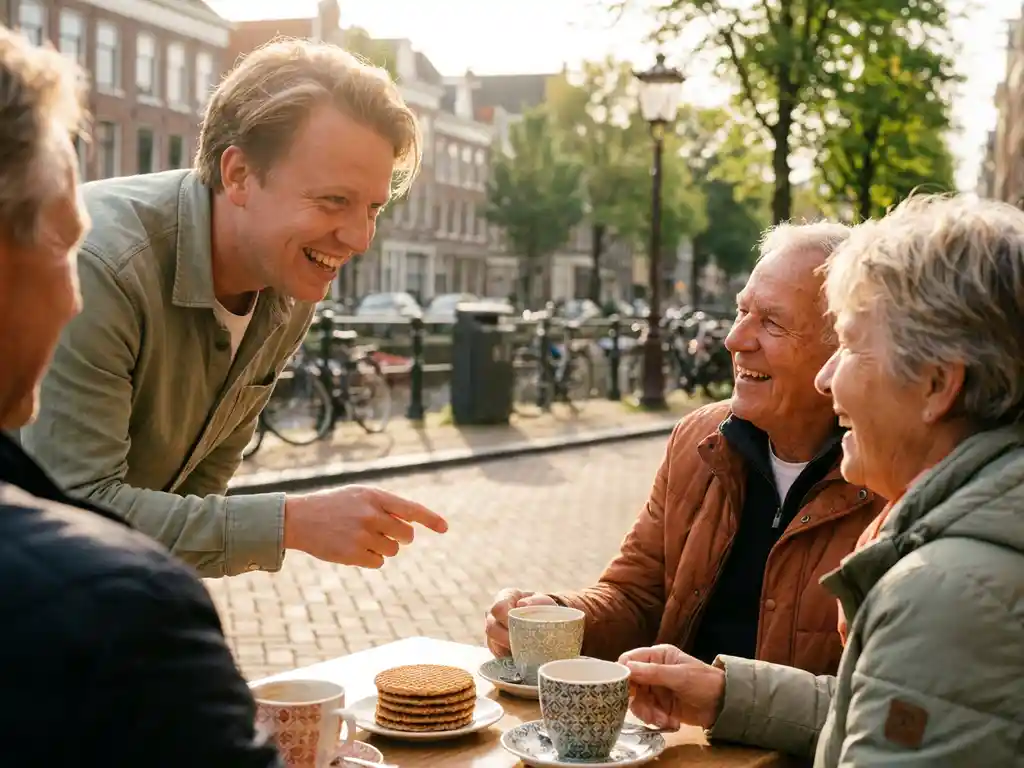
The social activities that work best for meeting Dutch people are those built around a shared purpose rather than socializing itself. Sports clubs, community volunteering, neighborhood associations, and hobby groups create the kind of repeated, low-pressure contact that Dutch friendships naturally grow from. Joining a local running club, a choir, or a community garden gives you a reason to show up consistently.
Expat social events and international meetups are useful for building a support network quickly, but they rarely lead to deep connections with local Dutch people. If your goal is to integrate into Dutch social life, prioritize activities where Dutch people are the majority. School parent communities, local sports associations, and neighborhood events are particularly effective because they give you shared context, shared experiences, and a reason to keep meeting the same people over time.
How does speaking Dutch change your social opportunities?
Speaking Dutch fundamentally transforms your expat social life in the Netherlands. It shifts you from being a visitor in a conversation to an active participant. Dutch people genuinely appreciate the effort, and even basic Dutch opens doors that stay firmly closed when you rely entirely on English. Conversations become warmer, more spontaneous, and more personal.
Language is not just a communication tool in social settings; it carries cultural nuance, humor, and shared references. When you can joke in Dutch, understand a neighbor’s sarcasm, or follow a conversation at a birthday party without asking for a translation, your sense of belonging changes completely. Many expat partners describe learning Dutch as the single biggest turning point in their social integration. It removes the invisible wall that separates you from everyday Dutch life and gives you the confidence to initiate contact rather than waiting to be included.
Starting to learn Dutch from scratch may feel daunting, but even a conversational foundation at A1 or A2 level is enough to make a noticeable difference in how Dutch people respond to you socially.
How long does it take to form real friendships with Dutch people?
Forming genuine friendships with Dutch people typically takes one to two years of consistent contact. This timeline is longer than many expats expect, and it can feel frustrating when you are used to social cultures where friendships form more quickly. However, the Dutch approach to friendship is rooted in trust, and trust builds gradually through repeated shared experiences rather than a single good conversation.
The timeline shortens significantly when you are embedded in a regular activity, speak some Dutch, and show up consistently over time. Expats who integrate into a local sports club or neighborhood community often report meaningful friendships forming within a year. Expecting deep connection after a few weeks sets you up for disappointment; expecting it after a year of genuine effort is realistic.
What common mistakes push Dutch people away?
The most common mistakes expats make when trying to connect with Dutch people involve misreading Dutch directness and overcompensating with social behavior that feels performative to a Dutch audience. Excessive enthusiasm, over-complimenting, or pushing for closeness too quickly can make Dutch people uncomfortable rather than warm to you.
- Avoiding directness or giving vague, non-committal answers, which Dutch people often read as dishonesty
- Only socializing within expat bubbles and never making sustained effort to join local activities
- Relying entirely on English and not making any attempt to use Dutch, even simple phrases
- Treating social interactions as networking opportunities rather than genuine human connection
Dutch social culture rewards authenticity above all else. Be straightforward, show up reliably, and invest in the relationship without rushing it. That approach works far better than trying to accelerate intimacy through social performance.
Should expat partners join Dutch classes or international groups first?
Expat partners benefit most from joining Dutch language classes first, and then using international groups as a complementary support network rather than a replacement for local integration. Dutch classes provide language skills, cultural context, and a community of people in the same situation, all at once. International groups offer emotional support and practical advice but do not build the language foundation needed for deeper integration.
The two are not mutually exclusive, and both serve real needs. International groups help you feel less alone in the early weeks. Dutch classes give you the tools to eventually not need them as much. The expats who integrate most successfully tend to use international communities for emotional grounding while actively investing in language learning and local activities for long-term social connection.
How Dutch on Track Helps You Build a Social Life in the Netherlands
At Dutch on Track, we understand that learning a language is about far more than grammar and vocabulary. It is about gaining the confidence to walk into a room, start a conversation, and feel at home in your new country. Our Dutch language courses are designed specifically for expats and their partners, combining practical communication skills with the kind of social environment where real friendships begin.
- Small groups of 8 to 10 participants, so you genuinely get to know your classmates
- A communicative approach that gets you speaking from day one, in real-life situations
- Evening classes after work hours, making it easy to fit learning into a busy family schedule
- Courses from absolute beginner (A0) through to intermediate (B1), including our flagship Dutch in 1 Year program
Many of our students tell us that their Dutch on Track classmates became their first real social circle in the Netherlands, and that the language skills they built gave them the confidence to reach beyond it. If you are ready to take that step, schedule a free meeting with Dutch on Track and find out which course fits your life right now.
Frequently Asked Questions
What if I've been in the Netherlands for over a year and still haven't made any Dutch friends — where do I start?
Start by honestly assessing whether your current routine gives you repeated contact with the same Dutch people. One-off events and expat meetups rarely build local friendships. Pick one activity — a local sports club, a neighborhood volunteer group, or a Dutch language class — and commit to it consistently for at least three to six months. Consistency and familiarity are the foundations Dutch friendships are built on, and showing up regularly is more powerful than attending many different events once.
How do I handle the awkward silence or bluntness when trying to make small talk with Dutch colleagues or neighbors?
Reframe the silence as neutral rather than hostile — Dutch people are simply comfortable with quiet and do not feel the social obligation to fill it. Instead of defaulting to small talk, try asking a direct, genuine question about something you actually want to know. Dutch people respond well to straightforward curiosity and tend to open up when a conversation has real substance. Matching their directness, rather than trying to soften it with pleasantries, signals that you are someone worth talking to.
Can I realistically make Dutch friends if I only speak English?
It is possible but significantly harder, and the friendships that form are likely to stay more surface-level. Most Dutch people speak excellent English and will switch for your convenience, but that switch can unintentionally create a dynamic where you remain a guest in the conversation rather than a full participant. Even reaching A1 or A2 level in Dutch — enough to greet people, follow basic exchanges, and attempt a joke — shifts the social dynamic noticeably. The effort itself communicates respect and genuine commitment to living in the Netherlands, which Dutch people value highly.
Are there specific types of sports clubs or hobby groups that are more welcoming to expats than others?
Clubs built around individual effort within a team setting — such as running clubs, cycling groups, rowing, or amateur football — tend to be particularly accessible because participation does not require advanced language skills to get started. Activities with a natural social element after the session, like a post-run coffee or a club bar evening, give you low-pressure time to build familiarity. Avoid clubs with very high skill barriers if you are a beginner, as the learning curve can limit your social bandwidth. Smaller, local clubs often integrate newcomers more organically than large, competitive ones.
How do I know if a Dutch acquaintance is becoming a real friend, or if I'm misreading the relationship?
A reliable signal is whether they initiate contact or invite you to something outside your regular shared activity. Dutch people do not extend invitations out of politeness — if you are invited to a birthday party, a home dinner, or a weekend plan, it is a genuine signal of growing trust. Another indicator is whether conversations become more personal and less activity-focused over time. If someone starts sharing opinions, asking about your life, or checking in without a specific reason, the friendship is real and progressing.
What is the best Dutch language level to aim for before I start feeling socially confident in everyday situations?
Most expats report a meaningful shift in social confidence around the A2 to B1 level. At A2, you can handle everyday conversations, understand the gist of what is being said around you, and respond without long pauses. At B1, you can follow group conversations, express opinions, and understand humor and sarcasm — which is where social belonging really begins to feel natural. You do not need to be fluent to integrate socially; you need to be functional and willing to make mistakes without embarrassment.
My partner has made Dutch friends through work, but I'm at home and struggling. What's the most effective first step I can take this week?
The single most effective first step is enrolling in a Dutch language course with a communicative, group-based format. It immediately gives you a structured reason to leave the house, puts you in a room with people in the same situation, and starts building the language skills that unlock everything else. While you are waiting for the course to begin, identify one local recurring activity — a parent group, a neighborhood association meeting, or a local club — and show up once just to observe. Momentum matters more than the perfect first move.