
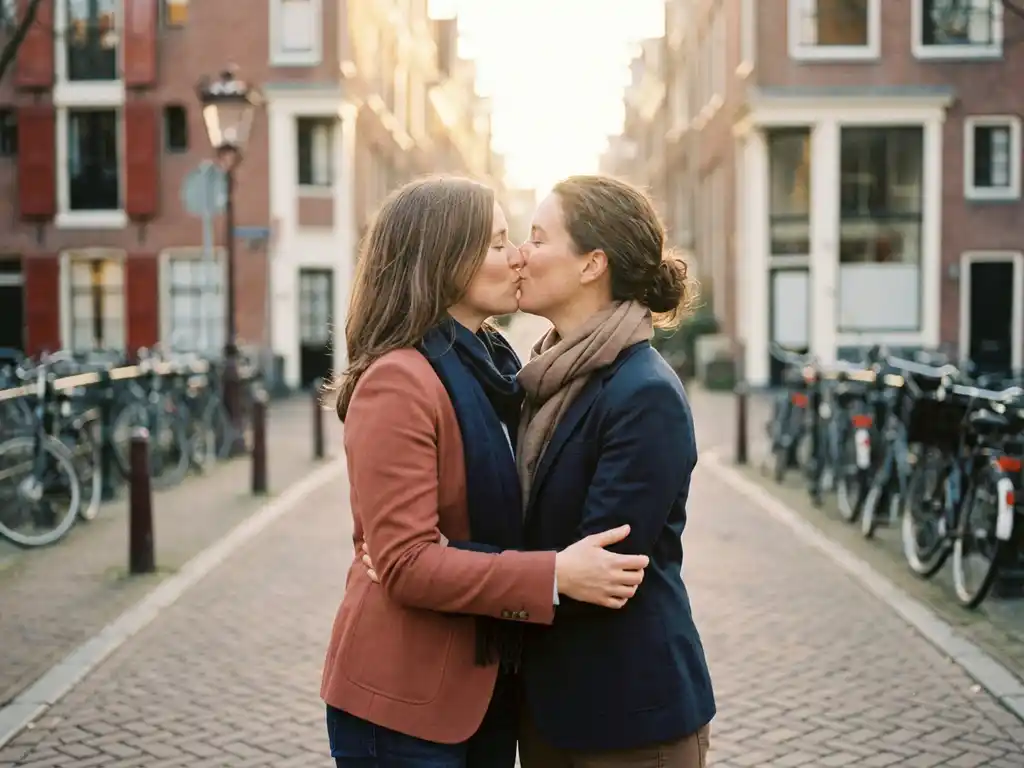
How many kisses do the Dutch give?
Dutch social customs can feel like a minefield when you first arrive in the Netherlands. One of the most common sources of culture shock in the Netherlands is the greeting ritual—specifically, the kissing. How many kisses do you give? Who do you kiss? And what happens when you lean in for two and the other person is already going for a third? Understanding these unwritten rules can make a real difference in how quickly you feel at home here.
Whether you are an expat, a partner who has just relocated, or an international professional navigating Dutch social life for the first time, this guide answers every question you have been too embarrassed to ask. Let’s clear up the confusion once and for all.
How many kisses do the Dutch actually give when greeting?
The Dutch typically give three kisses on the cheek when greeting someone they know—right, left, right. This three-kiss greeting is the standard social norm in the Netherlands and sets it apart from neighboring countries like Belgium and France, where two kisses are more common. If you are caught off guard expecting two, you are not alone.
The three-kiss sequence follows a consistent pattern: you start with the right cheek, move to the left, and finish with the right again. In practice, the kisses are more of a light cheek-to-cheek touch than a full kiss, often accompanied by a brief embrace. The whole thing happens quickly, so hesitating mid-greeting tends to create the awkward moment most newcomers dread. Once you know the rhythm, it becomes second nature.
When do the Dutch kiss on the cheek and when do they shake hands?
The Dutch kiss on the cheek when greeting friends, family, and people they know socially. In professional or formal settings, a firm handshake is the standard greeting, especially when meeting someone for the first time. The context—social versus professional—is the clearest guide to which greeting is appropriate.
At a birthday party, a neighborhood gathering, or a social dinner, expect cheek kisses all around. At a business meeting, job interview, or formal introduction, stick to a handshake. The transition between these two modes can happen surprisingly quickly in Dutch culture. A colleague you have only ever shaken hands with at work might greet you with three kisses the moment you run into them at a weekend barbecue. The setting shifts, and the greeting shifts with it.
What about acquaintances you are meeting for the second or third time?
Once you have been introduced to someone in a social context, the three-kiss greeting tends to stick from that point forward. The Dutch generally do not revert to a handshake after the first social meeting. If you met someone at a friend’s dinner party and you see them again at a casual event, kisses are expected. When in doubt, follow the lead of the Dutch person you are greeting.
Do Dutch men kiss other men when greeting?
Yes, Dutch men do kiss other men on the cheek as a greeting, but typically only when there is an existing close relationship—such as between family members or very good friends. In broader social settings, men more commonly greet each other with a handshake or a brief hug, reserving the three-kiss greeting for women or close male relatives.
This is one of the nuances that surprises many expats, particularly those from cultures where any physical male-to-male greeting beyond a handshake is uncommon. In the Netherlands, the cheek kiss between men signals genuine closeness rather than formality. If a Dutch man greets you with three kisses, take it as a sign that he considers you a real friend. It is a warm gesture, not an awkward one.
Why do the Dutch greet with three kisses instead of two?
The three-kiss tradition in the Netherlands is a deeply rooted cultural custom, though its exact historical origins are debated. The most widely accepted explanation is that three kisses became the Dutch norm as a way to distinguish the greeting from the two-kiss customs of neighboring countries, reinforcing a sense of Dutch cultural identity. It is simply how it has been done for generations.
Regional variation does exist within the Netherlands. In some areas, particularly in the south, such as Noord-Brabant and Limburg, three kisses are especially prevalent. In larger cities like Amsterdam, you may occasionally encounter people who prefer two kisses or even a simple hug, particularly among younger generations. The three-kiss norm is strongest in social and family contexts rather than in urban professional environments. As a newcomer, defaulting to three is always the safer bet.
What are the most common mistakes expats make with Dutch greetings?
The most common mistakes expats make with Dutch greetings include stopping at two kisses, leaning in for a kiss in a professional setting where a handshake is expected, and overthinking the whole thing until the moment becomes genuinely awkward. Misjudging the context—social versus formal—is the root cause of most greeting mishaps.
Here are the pitfalls to watch out for:
- Stopping at two kisses — This leaves the Dutch person mid-motion and creates an awkward pause. Always go for three in social settings.
- Initiating a kiss in a formal or professional context — A handshake is the safe default when meeting someone for the first time in a work environment.
- Hesitating or second-guessing — The greeting happens fast. Overthinking it slows everything down and makes it feel more uncomfortable than it needs to be.
- Misreading Dutch directness as coldness — The Dutch are famously direct, but this does not mean they are unfriendly. Their warmth shows up in these social rituals once you are in their circle.
The good news is that Dutch people are generally understanding toward internationals navigating these customs for the first time. A small misstep in the greeting department is rarely taken personally. What matters more is showing genuine effort to engage with Dutch social life and culture on its own terms.
How can learning Dutch help you navigate social customs more confidently?
Learning Dutch does more than help you order coffee or read street signs—it gives you direct access to the social codes, humor, and cultural references that shape everyday Dutch interactions. Language and culture are deeply intertwined, and understanding Dutch helps you pick up on the subtle cues that guide social situations, including greetings, small talk, and navigating the famous Dutch directness.
When you speak even a little Dutch, conversations open up in a way that English rarely allows. Dutch people genuinely appreciate the effort, and it signals that you are here to integrate, not just pass through. That shift in perception can make a real difference in how quickly you build friendships and feel part of your community. You can also learn Dutch with AI-powered tools to build confidence at your own pace before diving into social situations.
At Dutch on Track, we believe that the social side of language learning is just as important as grammar. Our small group classes of 8 to 10 students create a space where you practice Dutch with other internationals going through the same experience—which means you are not just learning a language; you are building a network. Our communicative approach means you speak from day one, which is exactly the kind of confidence-building practice that makes real-life social moments feel less daunting. Whether you are trying to navigate a birthday party full of Dutch customs or simply want to connect more authentically with your neighbors, our Dutch language course gives you the tools and the community to make it happen. You can also schedule a free meeting with our team to find the right starting point for your learning journey.
Frequently Asked Questions
Is it ever acceptable to opt out of the three-kiss greeting if I'm not comfortable with it?
Yes, and most Dutch people will respect it if you politely indicate your preference — especially if you are new to the country. A simple smile and an extended hand is a universally understood signal. That said, making a visible effort to engage with the custom, even imperfectly, tends to go over better than avoiding it altogether, as it shows cultural goodwill.
How do I handle a group greeting at a Dutch birthday party without it turning into chaos?
At Dutch birthday parties, it is standard to greet every single person in the room individually — yes, every one of them. Work your way around the room systematically, making brief eye contact and going through the three-kiss sequence with each guest. It can feel time-consuming at first, but skipping people is considered rude, so embrace the ritual and treat it as your first real Dutch social workout.
What should I do if I accidentally go for a kiss when the other person extends a hand for a handshake?
Laugh it off — genuinely. The Dutch have a good sense of humor and appreciate people who do not take themselves too seriously. A quick u0022sorry, still learning the Dutch wayu0022 with a smile defuses the moment instantly. These small collisions happen even between Dutch people, and they rarely leave a lasting impression.
Do Dutch greeting customs differ for older versus younger generations?
Yes, noticeably so. Older generations and those in more traditional or rural communities tend to follow the three-kiss norm quite strictly in social settings. Younger Dutch people, particularly in cities like Amsterdam, Rotterdam, or Utrecht, are more likely to mix in hugs, fist bumps, or even a simple wave among close friends. When in doubt with younger crowds, mirror what the Dutch person initiates rather than assuming three kisses is always the default.
Are there any other Dutch social customs I should know about alongside the greeting ritual?
Absolutely. A few that catch expats off guard: always bring a small gift or flowers when invited to someone’s home, expect to be asked directly and honestly for your opinion (the Dutch do not sugarcoat), and never be late — punctuality is taken seriously in both social and professional settings. Understanding these customs alongside the greeting ritual will help you build Dutch friendships much more naturally.
How long does it typically take to feel comfortable with Dutch social customs as an expat?
Most expats report that the physical awkwardness of greetings fades within a few weeks of regular social interaction. The deeper customs — understanding Dutch directness, humor, and social expectations — take longer, often several months to a year, and are significantly accelerated by learning the Dutch language. Immersing yourself in local settings like neighborhood events, sports clubs, or language classes speeds up the process considerably.
Can learning Dutch really make a difference in how Dutch people treat me socially, or is it just about communication?
It goes well beyond communication. Speaking Dutch — even at a basic level — signals genuine commitment to integrating into the culture, which the Dutch respect deeply. It unlocks humor, idioms, and conversational nuances that simply do not translate, and it shifts the dynamic from u0022foreign visitoru0022 to u0022someone who belongs here.u0022 Many expats describe learning Dutch as the single biggest turning point in building real, lasting friendships with locals.