Where do most American expats live in the Netherlands?
Most American expats in the Netherlands settle in Amsterdam, The Hague, and Eindhoven. Amsterdam draws the largest share due to its international business scene and English-friendly culture, while The Hague attracts diplomatic and legal professionals, and Eindhoven pulls in tech and engineering talent. Beyond those three, cities like Rotterdam and Utrecht also host growing American communities. This article walks through each city’s appeal and what American expats should know before choosing where to put down roots.
Which Dutch cities have the largest American expat communities?
The largest American expat communities in the Netherlands are concentrated in Amsterdam, The Hague, and Eindhoven. Amsterdam leads by a wide margin, followed by The Hague, which has a uniquely high concentration of American government and NGO workers. Eindhoven has grown rapidly as a hub for American professionals in the tech and semiconductor industries.
Rotterdam, Utrecht, and Maastricht also have visible American populations, though smaller in scale. Rotterdam appeals to Americans in logistics, engineering, and architecture. Utrecht attracts those working in healthcare and research. What most of these cities share is strong international infrastructure, English-language services, and well-connected transport links that make daily life manageable before Dutch language skills are fully developed.
In 2026, the Netherlands continues to be one of the most popular European destinations for American professionals relocating abroad, largely because of its high English proficiency, stable economy, and quality of life.
Why do so many American expats choose Amsterdam?
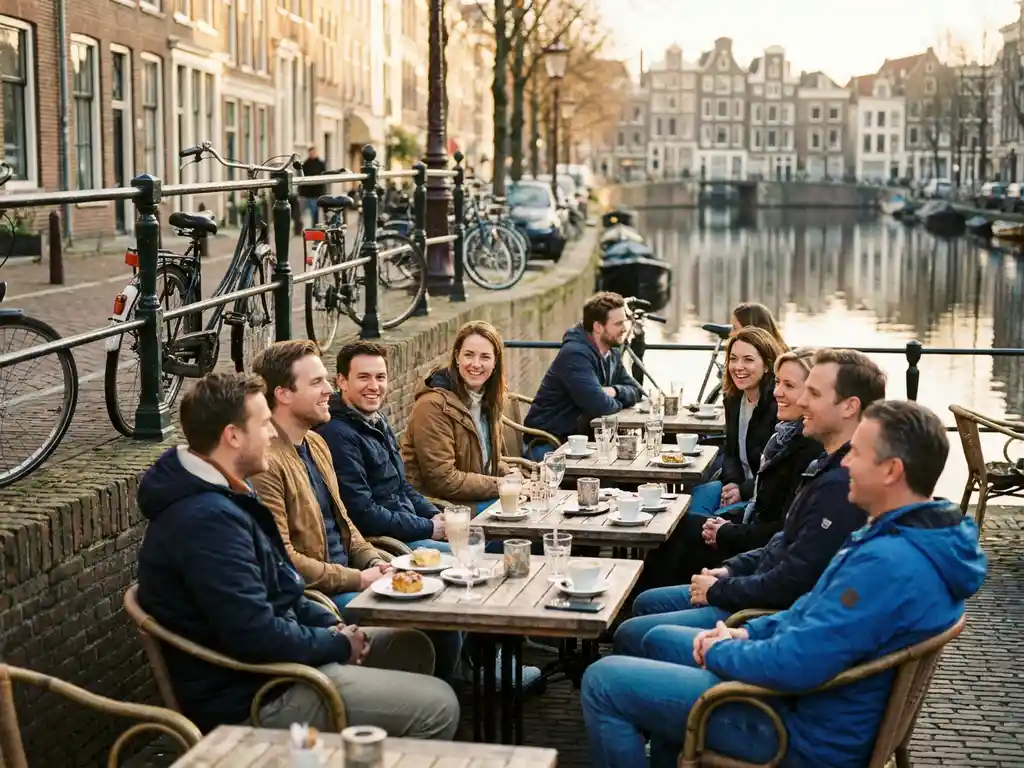
American expats choose Amsterdam because it combines a world-class international business environment with a vibrant, English-friendly social scene. The city hosts the European headquarters of many American multinationals, making it a natural landing spot for corporate relocations. Its compact, walkable layout and rich cultural life make settling in feel relatively smooth compared to other major European capitals.
Amsterdam’s neighborhoods vary considerably in character. The Jordaan and Oud-Zuid attract families and professionals who want a quieter, residential feel. Areas like De Pijp and Oost appeal to younger Americans drawn to independent restaurants, markets, and a more mixed local crowd. Expats with children often gravitate toward neighborhoods with easy access to international schools, which are well established across the city.
One thing worth noting: Amsterdam can feel like an English-speaking bubble. While that eases the initial transition, it can also slow down language learning and genuine integration. Many Americans who have lived in Amsterdam for a year or more say that making Dutch friends and feeling truly at home required a conscious effort to step outside the expat circle and engage with local culture and language.
Why is The Hague popular with American expats and their families?
The Hague is popular with American expats because it is home to numerous international organizations, embassies, and legal institutions that employ large numbers of American professionals. The presence of the U.S. Embassy, NATO offices, and international courts creates a ready-made community of American and English-speaking residents, making it one of the most internationally oriented cities in the Netherlands.
Families are particularly drawn to The Hague for practical reasons. The city has a well-developed network of international schools, including options following American curricula, which eases the transition for children. Neighborhoods like Wassenaar and the Benoordenhout are especially popular with American families who want spacious housing, green surroundings, and proximity to both the city center and the beach at Scheveningen.
The Hague also tends to feel slightly less hectic than Amsterdam, which appeals to families and professionals who want a high quality of life without the intensity of a major capital city. The expat social life in the Netherlands is particularly rich in The Hague, with active international community groups, cultural events, and regular networking opportunities that help newcomers build connections quickly.
What makes Eindhoven attractive for American expats in tech?
Eindhoven attracts American expats in tech because it is the home of ASML, one of the world’s most strategically important technology companies, along with a dense ecosystem of high-tech suppliers, startups, and research institutions connected to the High Tech Campus. American engineers, researchers, and business professionals are recruited to Eindhoven in significant numbers, making it one of the fastest-growing expat destinations in the Netherlands.
Compared to Amsterdam, Eindhoven offers a noticeably lower cost of living, shorter commutes, and a more relaxed pace of life. Housing is more affordable, and the city has invested heavily in cultural infrastructure, including the Van Abbemuseum, a lively design scene rooted in its history with Philips, and a growing restaurant and bar culture around the Stratumseind and Strijp-S districts.
For American expats and their partners moving to Eindhoven, one of the key challenges is that the city is less English-saturated than Amsterdam. Dutch is used more consistently in daily life, which makes language learning both more necessary and, ultimately, more rewarding. Many expat partners in Eindhoven find that learning Dutch opens up a genuine social life beyond the immediate expat community, and the city’s scale makes it easier to feel like a local once you have even basic conversational skills.
How do American expats typically find their neighborhood in the Netherlands?
American expats typically find their neighborhood through a combination of employer guidance, expat community forums, and housing platforms like Funda or Pararius. Many large employers provide relocation support that includes neighborhood recommendations based on family situation, commute, and school preferences. Online communities, including Facebook groups for American expats in specific cities, are frequently used to ask for firsthand advice.
Beyond logistics, neighborhood fit often comes down to lifestyle priorities:
- Families with children prioritize proximity to international schools and parks
- Young professionals without children often prefer urban neighborhoods with active social scenes
- Those focused on integration tend to choose areas with fewer expats and more Dutch neighbors
- Commute time and public transport links are consistently among the top deciding factors
It is worth visiting shortlisted neighborhoods on foot at different times of day before committing. Dutch neighborhoods can feel very different depending on whether you arrive on a quiet Sunday morning or a busy weekday evening. Talking to locals, even briefly, gives a much more honest picture than any online description.
What challenges do American expats face when settling in the Netherlands?
American expats settling in the Netherlands most commonly face challenges around bureaucracy, housing costs, and language barriers. The Dutch administrative system, from registering at the municipality to navigating healthcare, requires persistence and often basic Dutch literacy. Housing in cities like Amsterdam is highly competitive, and finding a suitable rental at a reasonable price can take longer than expected.
Language is a consistent friction point, even in a country where English is widely spoken. While daily tasks like shopping or ordering coffee are manageable in English, deeper integration, including making Dutch friends, understanding local humor, or navigating medical or school appointments, requires at least conversational Dutch. Many American expats underestimate how much their social life and sense of belonging depend on language.
Partners who relocate to support a spouse’s career often feel this most acutely. Without a workplace providing built-in social structure, the responsibility to build a social life falls entirely on the individual. Learning Dutch in a group setting, rather than through an app alone, addresses both the language gap and the social isolation at the same time. Dutch on Track was built precisely for this situation, combining structured language learning with a genuinely social classroom experience where expats meet others in the same position.
How Dutch on Track Helps You Build a Real Life in the Netherlands
Learning Dutch is about more than grammar. It is about feeling confident at the school gate, chatting with neighbors, navigating the doctor’s office, and building friendships that go beyond the expat bubble. That is exactly what we focus on at Dutch on Track.
Our courses are designed for highly educated internationals, including expat partners, who want practical language skills they can use from day one. Here is what makes our approach different:
- Small groups of 8 to 10 participants, so you practice speaking in every session and make real connections with fellow internationals
- A blended learning method combining e-learning preparation, interactive classroom sessions, and consolidation, so lessons stick
- A communicative approach where you speak Dutch from the very first class, building confidence rather than waiting for perfection
- Courses from absolute beginner (A0) through to intermediate (B1), including our flagship beginner Dutch course for those just starting out
Classes take place after work hours at central locations in Eindhoven and Tilburg, making them easy to fit around family and work schedules. If you are ready to move beyond survival Dutch and start genuinely connecting with life in the Netherlands, we would love to meet you. Schedule a free meeting with Dutch on Track and take the first step toward feeling at home.
Frequently Asked Questions
How long does it typically take for American expats to feel settled in the Netherlands?
Most American expats report that the practical side of settling in — finding housing, registering with the municipality, and establishing daily routines — takes around three to six months. Feeling genuinely at home socially and culturally tends to take longer, often one to two years, and is closely tied to language progress. Expats who invest in learning Dutch early consistently report feeling settled sooner than those who rely solely on English.
Do I need to speak Dutch to get by as an American expat in the Netherlands?
You can manage daily life in English, especially in Amsterdam and The Hague, but relying entirely on English creates a ceiling on how integrated you will feel. Deeper experiences — building Dutch friendships, navigating healthcare or school meetings, understanding workplace culture — all become significantly easier with at least conversational Dutch. Most expats who have been in the Netherlands for two or more years say learning Dutch was one of the best decisions they made.
What is the best Dutch city for American expat families with school-age children?
The Hague is widely considered the most family-friendly option, largely because of its strong network of international schools, including institutions following American curricula, and its spacious, green residential neighborhoods like Wassenaar and Benoordenhout. Amsterdam is also a solid choice given its well-established international school options, though housing costs and urban density are higher. Eindhoven is increasingly viable for families, particularly those connected to ASML or the High Tech Campus, with more affordable housing and a growing international school presence.
How competitive is the housing market for American expats arriving in the Netherlands?
The rental market in Amsterdam is extremely competitive, with desirable properties often rented within days of listing. The Hague and Utrecht are somewhat easier but still fast-moving. Eindhoven offers the most accessible rental market among major expat destinations, with more inventory and lower price points. Arriving with employer relocation support, a clear budget, and accounts set up on platforms like Funda and Pararius before you land gives you a meaningful advantage.
What are the most common mistakes American expats make when choosing where to live in the Netherlands?
The most common mistake is choosing a neighborhood based on English-language convenience alone, which can lead to staying in an expat bubble and missing out on genuine integration. Another frequent misstep is underestimating commute times — Dutch cities are well connected, but cross-city commutes can add up quickly. Many expats also wish they had visited their shortlisted neighborhoods in person before signing a lease, as the feel of an area can differ significantly from what online listings and forums suggest.
Are there active social communities for American expats in the Netherlands beyond the workplace?
Yes, all three major American expat hubs — Amsterdam, The Hague, and Eindhoven — have active expat social communities. Facebook groups, Meetup events, international clubs, and city-specific expat networks are widely used for everything from housing advice to weekend activities. The Hague in particular has a rich international social scene tied to its diplomatic and NGO community. That said, many long-term expats find that Dutch language classes provide some of the most genuine and lasting social connections, since participants share the same experience of building a new life in the Netherlands.
When is the right time to start learning Dutch after arriving in the Netherlands?
The sooner the better — ideally within the first one to three months of arrival. Starting early means you build practical language skills while your daily routines are still forming, making it easier to apply what you learn immediately. Waiting until you feel u0022settledu0022 often means waiting indefinitely, as the urgency fades once English gets you through the basics. Group Dutch courses are especially effective for newcomers because they combine language learning with an immediate social network of people in exactly the same situation.
Related Articles
- What are the biggest challenges of integration in the Netherlands for expats?
- What surprises expats most about living in the Netherlands?
- Can you get certified after completing a Dutch language course?
- What is the difference between online and classroom Dutch courses?
- How do Dutch language courses prepare you for integration exams?