What happens in your first Dutch lesson and what can you expect?
Starting a new language is exciting, but it can also feel a little nerve-wracking—especially when you are new to a country and still finding your footing. If you have been wondering what actually goes on behind the classroom door during a first Dutch lesson, you are not alone. Many expats and internationals in the Netherlands search for a Dutch course online or in person and then hesitate, unsure what to expect. This article answers the most common questions so you can walk in with confidence—and maybe even a smile.
Whether you are considering an online Dutch learning course or a face-to-face group class in Eindhoven or Tilburg, understanding the format, the social dynamics, and the practical expectations will help you make the most of every lesson from day one.
What actually happens in your very first Dutch lesson?
In your very first Dutch lesson, you will focus on speaking, not grammar rules. Most beginner sessions start with simple introductions, basic greetings, and a few essential phrases you can use immediately in daily life. The goal is to get you talking as quickly as possible, building confidence through real conversation rather than textbook exercises.
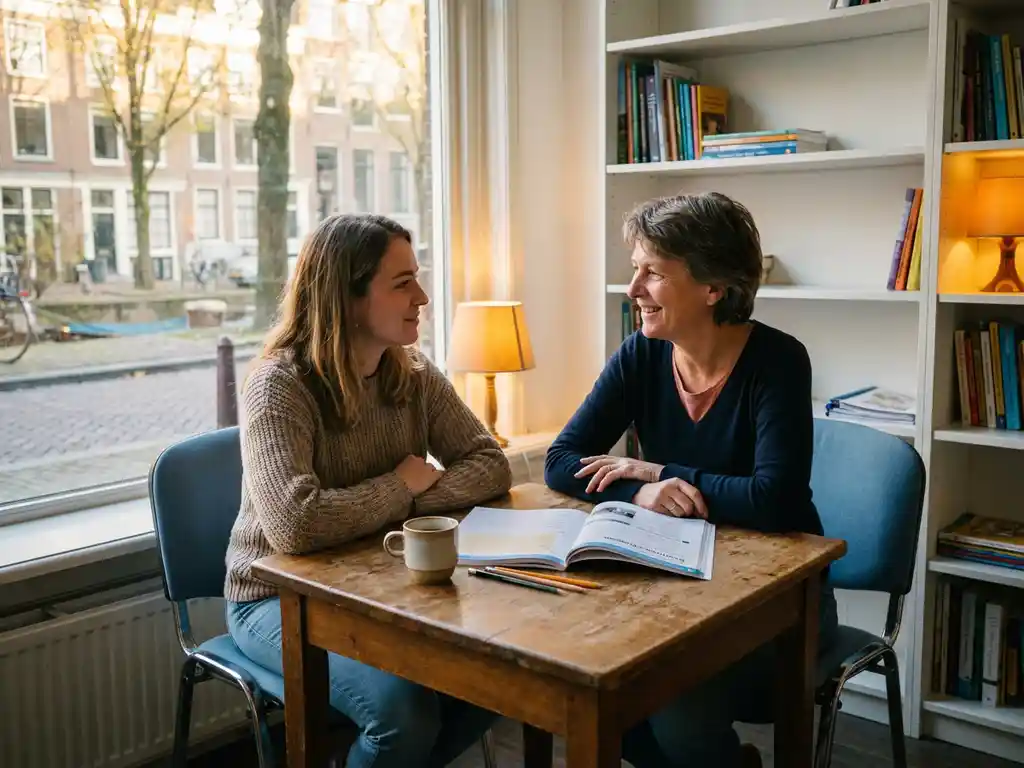
A typical first lesson involves meeting your fellow students, practicing how to introduce yourself in Dutch, and learning a handful of practical words and phrases. The atmosphere is deliberately relaxed and encouraging. Teachers understand that everyone in the room feels a little vulnerable, and that shared vulnerability is what makes the group dynamic so energetic and fun.
You will also get a sense of the lesson rhythm. In our blended learning approach, for example, students come to class having already done some e-learning preparation at home, so classroom time is spent practicing and interacting rather than passively absorbing new information. It feels less like school and more like a lively social gathering where Dutch happens to be the language of the evening.
How do Dutch language classes for expats differ from regular courses?
Dutch language classes designed for expats differ from standard language courses by focusing on practical, everyday Dutch rather than academic language structures. The content is built around situations expats actually encounter, such as navigating the supermarket, talking to neighbors, understanding workplace conversations, and making friends in a new city.
Regular language courses often cater to a broad audience with varied motivations, which means the pace and content can feel mismatched for someone who needs to function in Dutch society quickly. Expat-focused classes, on the other hand, assume that you are living in the Netherlands right now and that every lesson should be immediately useful.
There is also a strong cultural dimension. Learning Dutch as an expat is not just about vocabulary and grammar. It is about understanding why Dutch people communicate the way they do, what their directness really means, and how to build genuine connections with locals. A good course in Dutch language for internationals weaves these cultural insights into every lesson, helping you feel less like a visitor and more like someone who truly belongs. You can find out more about the people and philosophy behind this approach on the Dutch on Track about us page.
What level of Dutch do you need to join a beginner class?
You need absolutely no prior knowledge of Dutch to join a beginner class. Beginner courses, often labeled A0, are designed for people who are starting from zero. You do not need to know a single word. In fact, arriving with no Dutch at all is completely normal and expected.
The A0 level is specifically structured so that every concept is introduced from scratch. Teachers do not assume any background knowledge, and the pace is set to ensure everyone in the group moves forward together. If you have picked up a few words here and there from living in the Netherlands, that is a small bonus, but it is certainly not a requirement.
What matters far more than prior knowledge is your willingness to participate and your openness to making mistakes. A beginner class is a safe space where errors are not just tolerated but actively encouraged, because making mistakes is how language learning actually works.
How do small group Dutch lessons help with social integration?
Small group Dutch lessons support social integration by combining language practice with genuine human connection. When you learn Dutch alongside eight to ten other internationals who are navigating the same experience, you naturally build friendships, share tips about life in the Netherlands, and feel far less alone on your journey.
Language learning in a small group is one of the most underrated ways to build a social circle when you are new to a city. You see the same people week after week, you laugh at the same pronunciation mistakes, and you celebrate each other’s small wins. Many people who join Dutch classes end up making some of their closest friends in the classroom.
Beyond the social bonds formed within the group, improved Dutch skills directly open doors to wider integration. When you can hold a conversation at a neighborhood event, understand what your Dutch colleagues are saying over lunch, or chat with a local at the market, you stop feeling like an outsider. Language is the bridge between being present in a place and truly belonging to it.
What mistakes do beginners make in their first Dutch lessons?
The most common mistake beginners make in their first Dutch lessons is waiting until they feel ready before speaking. Many new learners spend too much time listening and not enough time practicing out loud, which slows progress significantly. Speaking imperfectly from day one is far more effective than waiting for perfection that never quite arrives.
A few other patterns come up regularly among new Dutch learners:
- Translating word for word from English or their native language instead of thinking in Dutch phrases
- Skipping the preparation work before class and arriving without the vocabulary needed to practice
- Being too hard on themselves when they forget words or make grammar errors
- Avoiding conversations outside the classroom because they feel their Dutch is not good enough yet
The good news is that all of these mistakes are easy to correct once you are aware of them. A communicative teaching approach, where speaking is prioritized from the very first session, naturally helps students move past the fear of imperfection and start enjoying the process of learning. Tools like learning Dutch with AI support can also help you practice between lessons at your own pace.
Where can expats take Dutch lessons in Eindhoven and Tilburg?
Expats can take Dutch lessons in Eindhoven and Tilburg at central, easily accessible locations designed with working professionals in mind. In Eindhoven, classes are held at Pastoor Petersstraat 162, just an eight-minute walk from Eindhoven Central Station. In Tilburg, lessons take place directly opposite Tilburg Central Station in the city center.
Both locations are chosen specifically so that commuting to class after work is as straightforward as possible. All lessons run from 17:45 to 19:45, fitting neatly into an evening schedule without requiring you to rearrange your entire day. For those who prefer flexibility, online options are also available, making it possible to join a Dutch course online from wherever suits you best.
In-company training is another option for organizations that want to support their international employees directly in the workplace. Whether you prefer learning in a group setting, online, or within your company, there is a format that fits your lifestyle and goals. Visit the Dutch on Track contact page to ask about the option that suits you best.
How Dutch on Track helps you learn Dutch and feel at home
Dutch on Track offers a structured, social, and genuinely enjoyable path into the Dutch language for expats and internationals in Eindhoven and Tilburg. Our blended learning method combines e-learning preparation, interactive group lessons, and consolidation exercises so that every hour in class counts. But beyond the methodology, what makes the experience special is the community you build along the way.
Here is what you can expect when you join Dutch on Track’s language programs:
- Small groups of 8 to 10 students so you get real speaking time and make real connections
- Certified teachers who specialize in Dutch as a Second Language
- Courses from absolute beginner (A0) to intermediate (B1), including the flagship Dutch in 1 Year program
- A communicative approach that gets you speaking from your very first lesson
Learning Dutch is not just a practical skill. It is a way to feel confident, connected, and genuinely part of life in the Netherlands. If you are ready to take that step, Dutch on Track is here to make the journey as rewarding, social, and fun as possible. Schedule a free introductory meeting today to find out which course fits your level and schedule.
Frequently Asked Questions
How long does it typically take to reach a conversational level in Dutch?
Most expats reach a functional, conversational level of Dutch (around B1) within 12 to 18 months of consistent study, which is exactly what programs like Dutch in 1 Year are designed to achieve. The speed of your progress depends heavily on how much you practice outside the classroom — even small daily habits like listening to Dutch radio, reading Dutch subtitles, or chatting with neighbors make a significant difference. The more you integrate Dutch into your everyday life in the Netherlands, the faster the language starts to feel natural.
What should I bring or prepare for my very first Dutch lesson?
For a first lesson, you generally do not need to bring anything special beyond an open mind and a willingness to speak up. If you are enrolled in a blended learning course, check whether there is any e-learning preparation to complete beforehand — arriving having done the prep work means you will get far more out of the interactive classroom time. A notebook can be handy for jotting down words and phrases that stick with you, but heavy textbooks and flashcard decks are not necessary on day one.
Is an online Dutch learning course as effective as attending in-person classes?
An online Dutch course can be just as effective as in-person learning, provided it is structured around live interaction rather than passive video watching. The key factor is whether you are speaking, practicing, and engaging with a teacher and fellow students in real time — not simply consuming pre-recorded content alone. For expats with unpredictable schedules or those who live outside Eindhoven or Tilburg, a well-designed online group course offers the same communicative, social experience as a face-to-face class, just from a more convenient location.
What if I miss a lesson — will I fall too far behind to catch up?
Missing the occasional lesson is a normal part of life, and a good course structure accounts for this. In blended learning programs, the e-learning component means you can review the material covered in a missed session at your own pace before the next class. It is worth letting your teacher know in advance when possible, as they can flag anything critical you should catch up on. The most important thing is not to let one missed class become a reason to disengage entirely — consistency over the long term matters far more than any single session.
How do I know which Dutch course level is right for me if I have picked up some Dutch already?
If you have been living in the Netherlands for a while and have absorbed some Dutch informally, a placement process will help you find the right starting point — most language schools offer a short intake conversation or online placement test for this reason. Joining a level that is slightly too easy is far less productive than finding a group where you are genuinely challenged to speak and think in Dutch. When in doubt, reach out to the course provider directly and describe your current level; an experienced teacher can usually place you accurately after a brief conversation.
Can learning Dutch really help with my professional life in the Netherlands, or is English enough?
While English is widely spoken in Dutch workplaces, especially in international companies, speaking Dutch opens doors that English simply cannot. Dutch colleagues tend to switch to their native language in informal settings — lunch conversations, Friday afternoon drinks, hallway chats — and being able to join in those moments is where real professional relationships are built. Beyond networking, demonstrating an effort to learn the local language signals commitment and cultural respect, which is often noticed and appreciated by Dutch employers and colleagues alike.
What happens after I finish a beginner course — what are my next steps?
Completing a beginner course is a genuine milestone, and the natural next step is to continue into the next level without a long gap in between — language skills fade quickly without regular practice. Most structured programs offer a clear progression path from A0 through to B1 or beyond, so ask your course provider about the follow-on course before your current one ends. Alongside formal classes, start setting yourself small real-world challenges: order your coffee in Dutch, write a short message to a Dutch contact, or watch a Dutch TV show with subtitles — these habits bridge the gap between the classroom and real fluency.