What should you compare before choosing between online Dutch courses?
Before choosing between online and in-person Dutch language courses, compare five key factors: learning format and flexibility, speaking practice opportunities, pace and structure, group size, and how well the schedule fits your daily life. The right choice depends less on which format is objectively better and more on which one matches how you actually learn and what you need Dutch for. The questions below break down each comparison point so you can make a confident, informed decision.
What actually changes between online and in-person Dutch courses?
The most significant difference between online and in-person Dutch language courses is the quality of real-time interaction. In-person courses offer face-to-face conversation practice, immediate feedback from a teacher, and spontaneous peer interaction that mirrors how Dutch is actually used in daily life. Online courses offer flexibility and convenience, but structured speaking practice requires deliberate design to replicate that environment.
Beyond interaction, the learning environment itself shifts. In a physical classroom, you are immersed in a social setting from the moment you walk in. Small talk before class, reactions to each other’s mistakes, and shared laughter over pronunciation all build confidence in ways that a screen rarely replicates naturally. Online courses can close this gap with live video sessions and breakout rooms, but it takes more intentional effort from both teacher and student.
A third dimension is accountability. Committing to a physical location at a fixed time creates a routine that many learners find easier to maintain. Online learners often need stronger self-discipline to show up consistently, especially when life gets busy.
How does learning pace differ between online and blended Dutch courses?
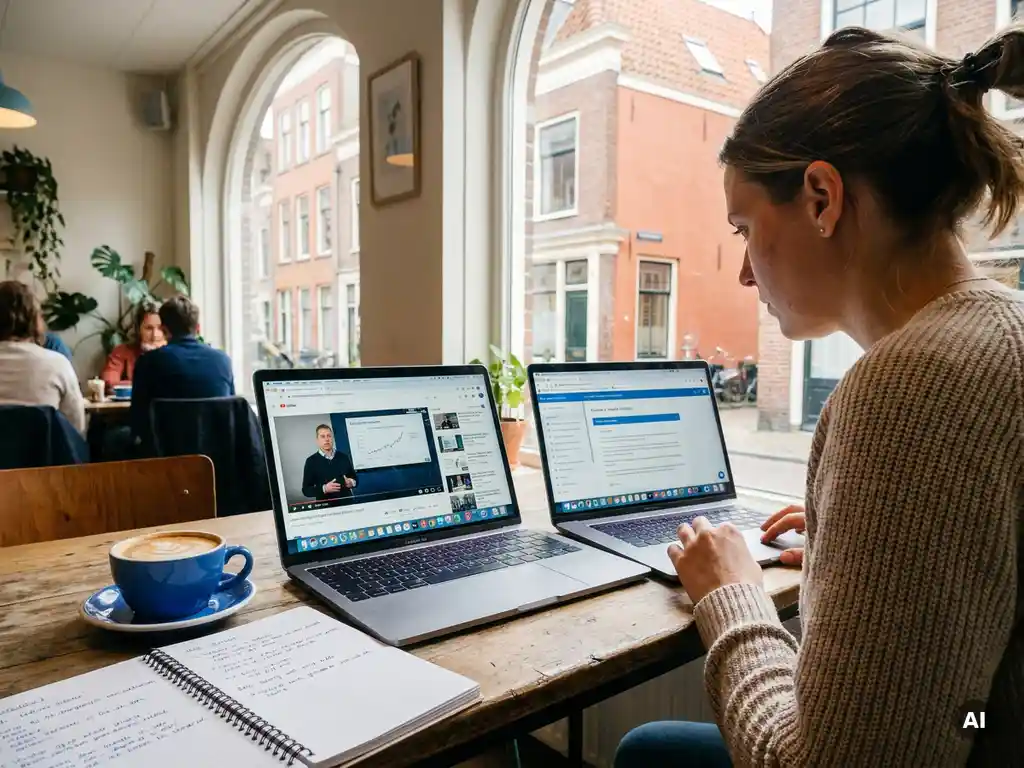
Online Dutch courses often allow self-paced progression, meaning you move through material at your own speed. Blended Dutch courses combine structured classroom sessions with digital preparation and consolidation, creating a fixed rhythm that balances flexibility with consistency. For most adult learners, blended formats produce more reliable progress because the classroom component creates regular checkpoints.
Self-paced online learning sounds appealing in theory, but without external deadlines many learners slow down or stall, particularly when topics become more challenging. A blended model solves this by anchoring your week around a live session while still giving you digital tools to prepare beforehand and review afterward.
The preparation phase in a blended course is especially valuable. When you arrive at class already familiar with the vocabulary and core structures of a lesson, you spend classroom time actually using the language rather than encountering it for the first time. This shifts the experience from passive reception to active practice, which accelerates real-world fluency.
What speaking practice does each Dutch course format offer?
In-person Dutch courses naturally generate more spontaneous speaking practice because conversation happens organically between classmates and with the teacher throughout the session. Online courses can offer structured speaking exercises, but the quality depends heavily on class size, platform design, and how actively the teacher facilitates interaction. Live online sessions with small groups come closest to replicating the in-person experience.
Speaking practice is where many Dutch learners feel the biggest gap between what they study and what they can actually do. Reading and listening exercises build comprehension, but fluency comes from speaking under mild pressure, making mistakes, and recovering. That process happens most naturally in a social setting.
Look for courses that prioritize speaking from the very first lesson rather than waiting until you have “enough” grammar. Communicative approaches that push you to express yourself with limited vocabulary build confidence faster than courses that delay conversation until you feel ready. Feeling ready rarely comes before speaking; it comes from speaking.
Which Dutch course level system should you look for?
Look for Dutch language courses that align with the Common European Framework of Reference for Languages (CEFR), which uses levels from A1 (absolute beginner) to C2 (mastery). A well-structured course system should offer clear level descriptions, placement assessments, and a defined path showing what you will be able to do in Dutch at each stage. This transparency lets you track progress and set realistic goals.
For most expats and their partners, reaching B1 level is a practical and meaningful milestone. At B1 you can handle most everyday situations independently: appointments, conversations with neighbors, parent evenings at school, and basic professional interactions. Knowing this target exists and seeing a structured path toward it makes the learning journey feel achievable rather than open-ended.
When comparing courses, ask specifically what you will be able to do at the end of each level, not just which grammar topics are covered. Outcome-based descriptions are a strong signal that the course is built around real-world use rather than academic exercises.
How do you compare Dutch course schedules to your daily routine?
Compare Dutch course schedules by mapping class times against your fixed weekly commitments: school runs, work hours, your partner’s travel schedule, and personal energy patterns. Evening classes after work hours are often the most practical for expat partners managing household responsibilities during the day. The best schedule is one you can attend consistently for months, not just the first few weeks.
Consistency matters more than intensity. A course that meets twice a week at a time that genuinely works for you will produce better results than an intensive daily program that you frequently have to skip. When evaluating schedules, think about your worst week, not your best one.
Also consider location. A course that is physically close to home or on a natural route in your week removes friction. The less effort it takes to get there, the more likely you are to show up when motivation dips, which it will at some point for every language learner.
Should you choose a Dutch course with a small group or solo lessons?
For most learners of Dutch, small group courses offer a better balance of speaking practice, peer learning, and social connection than one-on-one lessons. Solo lessons provide maximum personalization and scheduling flexibility, but they lack the social dynamics that make language learning more engaging and more realistic. A small group of eight to ten students creates enough variety in conversation partners while still allowing meaningful teacher attention.
Learning alongside others who are navigating the same experience adds a dimension that goes beyond language acquisition. You hear different accents, different questions, and different ways of expressing the same idea. You also build relationships with people who understand exactly what it feels like to live in a new country without yet speaking the language fluently. That shared experience often becomes one of the most motivating parts of the course.
Solo lessons can be a useful supplement, particularly if you have specific professional vocabulary needs or want to accelerate a particular skill. But as a primary format, group learning tends to produce more confident, socially capable speakers because it mirrors the actual conditions in which you will use Dutch.
How Dutch on Track helps you choose and learn with confidence
We designed our Dutch language courses specifically for highly educated internationals, expats, and their partners who want to become genuinely functional in Dutch, not just academically proficient. Here is what sets our approach apart:
- Blended learning methodology: Every course combines e-learning preparation, interactive classroom sessions in small groups of 8 to 10, and digital consolidation so you arrive ready to speak and leave with the material reinforced.
- Communicative approach from day one: We encourage speaking from the very first lesson because confidence comes from practice, not from waiting until you feel ready.
- CEFR-aligned levels from A0 to B1: Our structured path includes the flagship Dutch in 1 Year program, a 43-week journey that takes you from absolute beginner to intermediate level with clear milestones along the way.
- Practical, social, and fun: Classes happen in small groups where friendships form naturally. Learning Dutch becomes a way to build your social circle, connect with your new community, and rediscover yourself in a new country.
- Convenient locations and timing: Courses run after work hours in central Eindhoven and Tilburg, designed to fit around real life rather than disrupt it.
- Certified teachers: All our instructors are specialists in teaching Dutch as a Second Language, so you get professional guidance every step of the way.
If you are ready to find the right level and format for where you are now, schedule a free meeting with us and we will help you take the next step with confidence.
Frequently Asked Questions
How long does it typically take to reach B1 Dutch if I study consistently?
For most adult learners starting from scratch, reaching B1 level takes roughly 10 to 12 months of consistent study in a structured program, such as Dutch on Track’s 43-week Dutch in 1 Year course. The timeline can vary depending on your native language background — speakers of German or English tend to progress faster due to shared vocabulary and grammar structures. The key variable is consistency: learners who attend regularly and complete preparation exercises between sessions reach B1 significantly faster than those who study intensively for short bursts.
What if I've tried learning Dutch before and lost motivation halfway through?
This is extremely common and usually points to a format or schedule mismatch rather than a lack of ability. If you stalled with a self-paced online course, a blended format with fixed classroom sessions will give you the external accountability that keeps you moving forward. It’s also worth reflecting on whether your previous course prioritized speaking early enough — learners who spend months on grammar before having real conversations often lose motivation because progress feels invisible. Switching to a communicative approach where you speak from lesson one tends to reignite engagement quickly.
Can I join a Dutch course mid-level if I already have some basic knowledge?
Yes, most well-structured Dutch course providers offer placement assessments to identify exactly where you should enter the level system. Rather than starting from scratch at A1, you can be placed at A2 or even B1 depending on your existing skills. Be honest during the assessment about your speaking ability specifically — many learners overestimate their level because their reading comprehension is stronger than their conversational fluency, and joining a group that’s too advanced can be discouraging rather than motivating.
Is it worth learning Dutch if most Dutch people switch to English when they hear an accent?
Absolutely, and this is one of the most common frustrations expats raise — but it’s also a habit that changes as your Dutch improves. In the early stages, Dutch speakers often switch to English out of helpfulness, not judgment. As you reach A2 and B1, you gain the confidence to politely insist on continuing in Dutch, and most people will respect that. More importantly, speaking Dutch — even imperfectly — signals genuine integration and opens doors socially and professionally that staying in English simply doesn’t.
How important is it to practice Dutch outside of class, and what's the most effective way to do it?
Outside-of-class practice is essential for retaining what you learn and building real fluency, but it doesn’t have to mean hours of extra study. The most effective approach is integrating Dutch into your existing daily routine: switching your phone language, listening to Dutch radio or podcasts during your commute, or watching Dutch TV with Dutch subtitles. Even 15 to 20 minutes of daily exposure between sessions compounds significantly over a course. Blended courses that include e-learning preparation and consolidation exercises make this easier by structuring what to focus on outside the classroom.
What's the biggest mistake people make when choosing a Dutch language course?
The most common mistake is choosing a course based on price or convenience alone without checking whether the format actually matches your learning style and schedule. A cheap self-paced course that you abandon after three weeks costs more in the long run than an investment in a structured program you complete. A close second mistake is choosing a course that delays speaking practice until you feel “ready” — that moment rarely arrives on its own, and courses built around grammar-first approaches tend to produce learners who understand Dutch but struggle to use it in real conversations.
Can my partner and I take a Dutch course together, or is it better to learn separately?
Taking a course together can be motivating and makes it easier to practice at home, but it works best if you are genuinely at the same level — if one partner is significantly stronger, the dynamic can become unbalanced in class. Learning in the same cohort also means you share the social experience and can support each other through the harder stretches. That said, if your levels differ, joining separate groups and then practicing together at home is often the more effective arrangement for both of you.