Which A1-A2 Dutch course in Tilburg should you choose?
For expat partners in Tilburg, Dutch on Track’s A1 and A2 courses are among the strongest options available in 2026. They combine a communicative classroom approach with flexible blended learning, small groups of 8 to 10 people, and a location directly opposite Tilburg Central Station. If you are new to Dutch and want a course that fits around your life while helping you feel genuinely at home, this guide walks through everything you need to know before choosing.
What levels do A1 and A2 Dutch courses in Tilburg cover?
A1 is the absolute beginner level, where you learn to introduce yourself, handle simple everyday interactions, and understand basic vocabulary. A2 builds on that foundation, giving you the language to navigate daily life more independently, from visiting the doctor to chatting with your neighbours. Together, A1 and A2 form the lower beginner range of the Common European Framework of Reference for Languages (CEFR).
At A1, you focus on core structures: greetings, numbers, days of the week, shopping phrases, and simple questions. By the end of A2, you can hold short conversations on familiar topics, understand straightforward written texts, and manage routine tasks without always relying on someone else. For expat partners settling into life in the Netherlands, reaching A2 is often the point where daily life starts to feel noticeably less stressful.
What should you look for in a Dutch language course as an expat partner?
As an expat partner, the most important things to look for in a Dutch language course are a communicative approach that prioritises speaking from day one, practical content tied to real-life situations, small group sizes that allow genuine interaction, and a schedule that works around family and household responsibilities.
Many language learners spend hours on grammar exercises and vocabulary lists but still freeze when they need to speak at the school gate or the GP’s reception. A good course bridges that gap by putting conversation at the centre. Look for programmes where you practise with classmates in realistic scenarios, not just complete workbook exercises in isolation.
Beyond the teaching method, the social dimension matters more than many people expect. Joining a course with other internationals at a similar stage means you are not just learning Dutch, but you are building a social network in a new country. That sense of community, the shared laughter over a tricky pronunciation, and the friendships that form over coffee before class can be just as valuable as the language skills themselves.
How does blended learning compare to traditional classroom Dutch courses?
Blended learning combines self-paced digital preparation with interactive classroom sessions, while traditional classroom courses deliver all content face to face. Blended learning typically leads to more efficient use of classroom time because students arrive having already encountered new vocabulary and structures, allowing the group session to focus on practising and applying the language rather than introducing it from scratch.
In a traditional classroom setting, a teacher must balance explaining new material, drilling it, and giving students time to practise, all within the same session. This can leave limited room for the free, spontaneous conversation that actually builds confidence. With a blended approach, the e-learning component handles the groundwork, so classroom time becomes almost entirely communicative.
For expat partners juggling family schedules, the flexibility of completing preparatory modules at home, on the train, or during a quiet hour in the afternoon is a practical advantage. Consolidation activities after class reinforce what was covered, which research into language acquisition consistently supports as a key factor in long-term retention.
How long does it take to reach A2 Dutch starting from zero?
Starting from zero, most adult learners reach A2 level in roughly four to six months of consistent study, assuming regular weekly lessons and independent practice. The exact timeline depends on how often you study, how much Dutch you encounter in daily life, and how closely your native language resembles Dutch.
Speakers of German or Afrikaans typically progress faster because of structural similarities. Speakers of Romance languages or non-Indo-European languages may need a little more time, particularly with Dutch pronunciation and word order. That said, with a communicative course and daily exposure, even learners from very different linguistic backgrounds often reach functional A2 within six months.
What accelerates progress most is practice outside the classroom. Trying out phrases at the supermarket checkout, exchanging a few words with a neighbour, or listening to a Dutch podcast on the school run all compound the learning from formal lessons. A course that actively encourages this kind of real-world practice gives you a measurable advantage.
Where in Tilburg can expats take Dutch lessons?
In Tilburg, expats can take Dutch lessons at several language schools and community centres, with options ranging from municipal integration courses to private language schools offering more flexible, communicative programmes. The most convenient locations are those close to public transport, particularly the central station area, which is accessible from most parts of the city.
When evaluating locations, consider not just proximity but also the atmosphere of the learning environment. A central, welcoming space where you can arrive comfortably after the school run or before heading home makes a real difference to whether you actually keep attending week after week. Evening slots, which typically run after 17:30, tend to suit expat partners well because they work around school pick-up times and shared family commitments.
Which Dutch course in Tilburg is best for expat partners?
For expat partners in Tilburg, the best Dutch course is one that combines practical, communicative teaching with a supportive social environment, flexible scheduling, and a clear progression path from beginner to independent speaker. Dutch on Track ticks all of those boxes and is specifically designed for highly educated internationals in exactly this situation.
Here is what we offer that makes a genuine difference for expat partners:
- Blended learning method: e-learning preparation, interactive classroom sessions, and consolidation activities work together so every class hour is used for speaking and connecting, not just listening to explanations
- Small groups: classes of 8 to 10 participants mean you get real speaking time and build genuine friendships with people who understand your experience
- Evening schedule: lessons run from 17:45 to 19:45, designed around family life and household responsibilities
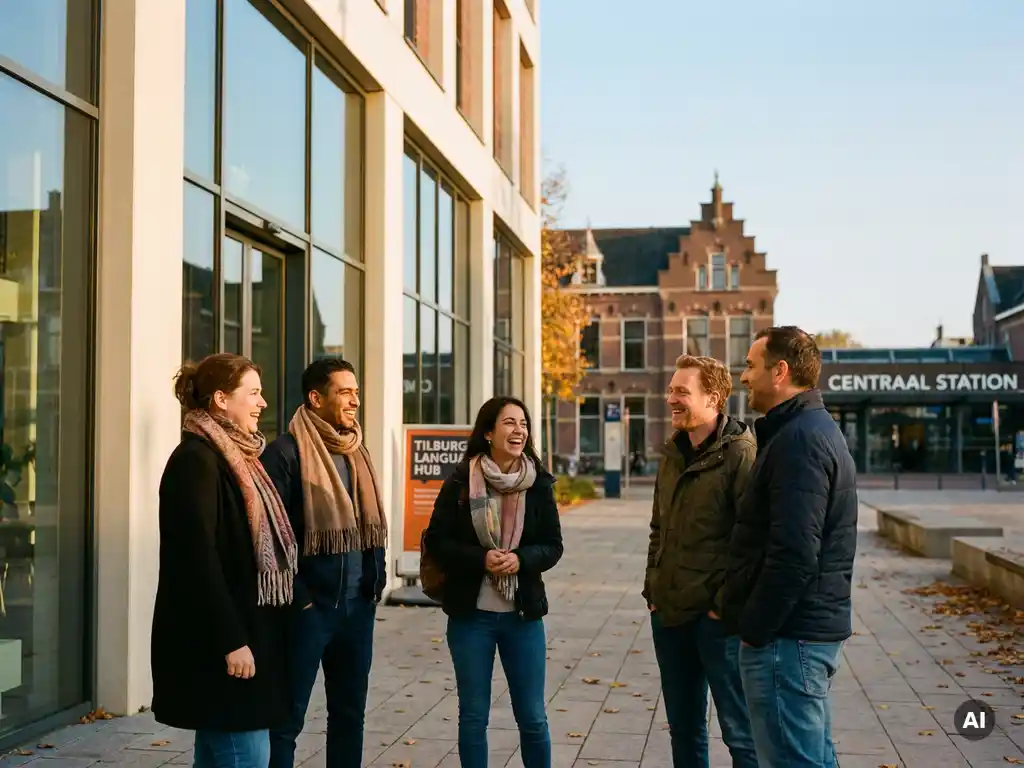
- Central Tilburg location: our classroom is directly opposite Tilburg Central Station, making it easy to reach from anywhere in the city
- Communicative approach from day one: we believe the most important thing is not being afraid to speak, so conversation starts immediately, mistakes and all
- Certified teachers: all our instructors specialise in Dutch as a Second Language, so you are in experienced hands throughout
- Clear progression: our courses take you from absolute beginner (A0) through to B1, with a structured path so you always know where you are headed
Learning Dutch is about more than passing a language test. It is about feeling confident at the school gate, laughing at a Dutch joke, making friends who are not just your partner’s colleagues, and building a life here that feels genuinely yours. We would love to be part of that journey. Schedule a free meeting with us to find the right course for where you are starting from.
Frequently Asked Questions
Can I join a Dutch A1 or A2 course in Tilburg if I have already picked up some basic Dutch on my own?
Yes, and it is actually very common. Before enrolling, most good language schools will offer a short intake conversation or placement assessment to determine whether A1 or A2 is the right fit for you. If you have taught yourself some basics through an app or casual exposure, you may be ready to start at A2 rather than A1, which saves you time and keeps the course content challenging enough to stay motivating. Be honest during the placement process so you land in the group where you will grow the most.
What if I miss a class due to family commitments or illness — will I fall too far behind?
Missing the occasional lesson is a normal part of life, especially for expat partners managing busy family schedules, and a well-structured course accounts for this. With a blended learning model, you can review the e-learning materials and consolidation activities at your own pace to catch up on what was covered. It is worth asking your language school upfront about their policy on missed lessons and whether catch-up support or recordings are available, so you are not caught off guard mid-course.
How much time should I set aside each week outside of class to make real progress?
As a general rule, plan for around two to three hours of independent practice per week on top of your classroom sessions. This does not have to mean sitting at a desk with a textbook — listening to a Dutch podcast during the school run, practising phrases at the supermarket, or spending 15 minutes on your e-learning module before bed all count. Little and often is far more effective for language retention than cramming, so consistency matters more than the total number of hours.
Is A2 Dutch enough to get by in daily life in the Netherlands, or do I need to keep going to B1?
A2 gives you a solid functional foundation — you can handle routine errands, follow basic conversations, and communicate your needs in most everyday situations, which makes daily life noticeably less stressful. However, for deeper social integration, workplace communication, or navigating more complex situations like parent-teacher meetings or medical appointments without a translator, progressing to B1 makes a significant difference. Think of A2 as the point where survival becomes comfort, and B1 as the point where comfort starts to feel like belonging.
Do I need to speak any Dutch before starting an A1 course, or is it truly for complete beginners?
A1 is designed for absolute beginners, so no prior knowledge of Dutch is needed or expected whatsoever. You will start from the very basics — greetings, introductions, numbers, and simple phrases — in a supportive environment where everyone in the room is at the same starting point. The only thing you need to bring is a willingness to speak from day one, even when it feels unfamiliar or a little awkward at first.
What is the most common mistake expat partners make when choosing a Dutch language course?
The most common mistake is prioritising price or convenience over teaching method, and ending up in a course that focuses heavily on grammar and written exercises rather than spoken communication. Many learners complete a full beginner course and still feel too nervous to hold a real conversation, precisely because they never practised speaking in a realistic, low-pressure setting. Before enrolling, ask specifically how much of each lesson is dedicated to speaking and interaction — the answer will tell you a lot about whether the course will actually build your confidence.
Can taking a Dutch course help with social integration beyond just the language itself?
Absolutely, and for many expat partners this turns out to be one of the most valuable and unexpected benefits. A small-group course brings together internationals who are navigating the same experience — the same cultural adjustments, the same moments of confusion, and the same milestones — which naturally creates a sense of community. The friendships formed in class often extend well beyond the classroom, giving you a social network that is entirely your own, independent of your partner’s work connections.