Which Dutch course in Eindhoven is best for improving your speaking skills?
The best Dutch course in Eindhoven for improving your speaking skills is one that prioritizes communication from day one rather than drilling grammar rules in isolation. Look for small group classes with a communicative teaching method, certified teachers, and a structure that pushes you to practice speaking in real-life situations, not just complete written exercises at home. The questions below break down exactly what to look for and what your options are in Eindhoven in 2026.
What makes a Dutch course effective for speaking practice?
A Dutch course is effective for speaking practice when it prioritizes spoken interaction over passive study. The most important factors are a communicative teaching approach, small group sizes that give every student time to speak, and lesson content tied directly to situations you will actually encounter in daily life: at the doctor, the supermarket, or with your neighbors.
Grammar has its place, but it should support conversation rather than replace it. Courses that spend most of the lesson on written exercises or teacher-led explanations tend to leave learners confident on paper but hesitant when a real Dutch person starts talking. The shift happens when you are put in situations where speaking is the only option.
Other markers of an effective speaking-focused course include:
- Small group sizes: groups of 8 to 10 students give everyone regular speaking turns without the pressure of one-on-one instruction
- Certified teachers who specialize in Dutch as a Second Language and know how to correct errors without breaking your confidence
- Structured progression through clearly defined levels so you are always being stretched, not bored or overwhelmed
- Encouragement to make mistakes: courses that treat errors as a normal part of learning help students speak more freely and improve faster
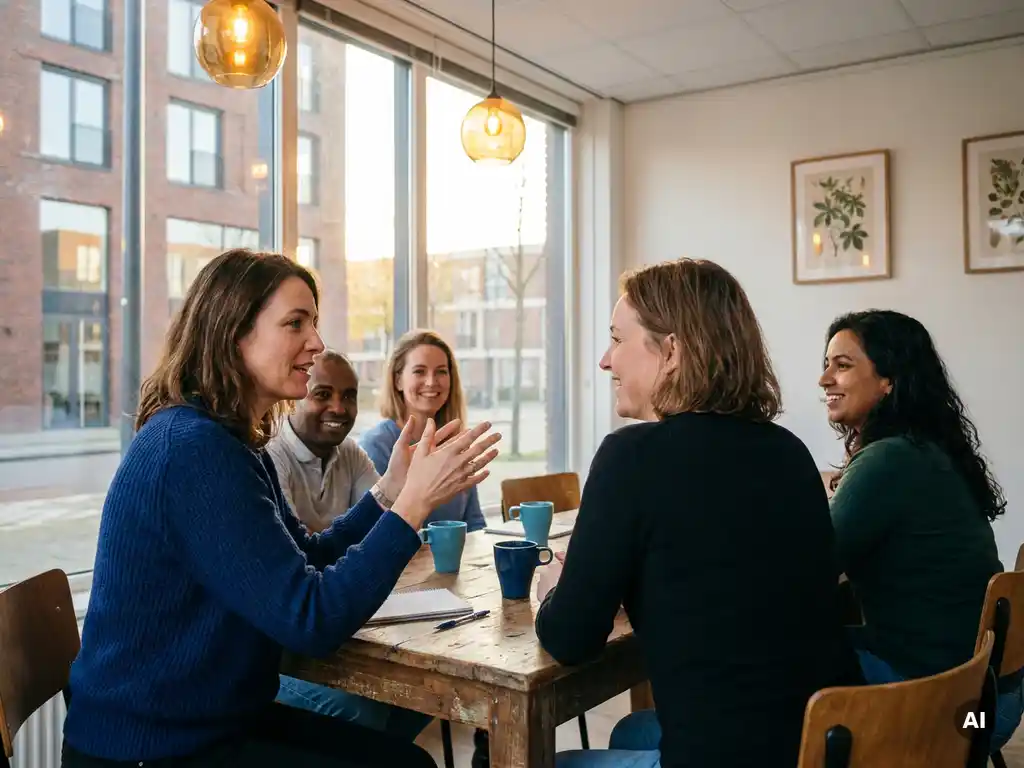
The social dimension matters too. Learning alongside fellow internationals who share similar experiences creates a relaxed, encouraging environment. Many students find that the friendships formed in class become part of the motivation to keep showing up and practicing.
What types of Dutch courses are available in Eindhoven?
In Eindhoven, Dutch language courses are available in several formats: in-person group classes, fully online courses, blended learning programs that combine both, and in-company training for organizations supporting international staff. Each format suits a different lifestyle and learning goal.
In-person group classes remain the most popular choice for expats and their partners who want genuine speaking practice and the social connection that comes with meeting people in the same situation. These classes typically run after work hours, making them accessible even for those with full daytime schedules or family responsibilities.
Online Dutch courses offer flexibility for people whose schedules or locations make commuting difficult. The trade-off is that live conversation practice depends heavily on how the course is structured; a self-paced video course is very different from a live virtual classroom with interactive exercises.
Blended learning programs sit between the two, combining self-paced digital preparation with interactive classroom sessions. This format has grown significantly in recent years because it allows students to arrive at each class already familiar with the vocabulary and structures, which means more class time can be spent actually speaking rather than being introduced to new material.
For those working for a company with an international workforce, in-company Dutch training brings the course to the workplace and can be tailored to professional vocabulary and scenarios relevant to that specific environment.
How does a blended learning method improve Dutch speaking skills?
A blended learning method improves Dutch speaking skills by separating the cognitive load of learning new material from the practice of using it. Students prepare vocabulary and key phrases independently before class, so when they arrive, the lesson can focus almost entirely on speaking, listening, and interacting with others rather than absorbing new information for the first time.
This structure solves one of the most common frustrations in language learning: the feeling that you spend hours studying at home but still freeze when you need to speak. When preparation happens digitally before the lesson and consolidation happens digitally afterward, the classroom becomes a dedicated space for communication.
The three-stage cycle works like this:
- E-learning preparation: students learn new vocabulary, listen to dialogues, and build familiarity with the lesson’s language at their own pace
- Interactive classroom session: the teacher facilitates conversation practice, role-plays, and group exercises using the material students already know
- E-learning consolidation: students reinforce what was practiced in class, helping move new language from short-term memory into longer-term recall
Beyond the structure, blended learning suits the lives of busy expat partners and professionals who cannot always commit to large blocks of study time. Short, focused digital sessions fit around childcare, work, and daily routines, while the in-person class provides the human connection and accountability that keeps motivation high.
What level of Dutch can you reach in a year of classes in Eindhoven?
With consistent attendance in a structured Dutch language course in Eindhoven, most learners can progress from absolute beginner level (A0) to intermediate level (B1) within a year. At B1, you can handle most everyday conversations, understand the main points of clear speech on familiar topics, and communicate in situations that arise during travel or daily life in the Netherlands.
This progression follows the Common European Framework of Reference for Languages (CEFR), which divides language ability into six levels from A1 to C2. The A0 to B1 journey covers:
- A0 to A1: introducing yourself, understanding simple instructions, managing basic transactions
- A1 to A2: describing your environment, handling routine exchanges, understanding frequently used expressions
- A2 to B1: participating in conversations on familiar topics, expressing opinions, understanding the main points of conversations and written texts
Reaching B1 in a year is a realistic goal when the course is well-structured, classes are held regularly, and students practice outside of lessons. It is not automatic: consistent attendance, active participation in class, and a willingness to use Dutch in everyday situations all make a significant difference to the pace of progress.
For expat partners especially, B1 is a meaningful milestone. It is the level at which daily life in the Netherlands starts to feel genuinely manageable: talking to teachers at school, calling a GP, chatting with neighbors, or navigating the gemeente without needing a Dutch-speaking companion.
Should you choose online or in-person Dutch classes in Eindhoven?
For most learners focused on improving their speaking skills, in-person Dutch classes in Eindhoven are the stronger choice. Face-to-face interaction creates more natural conversation practice, stronger social bonds with classmates, and a level of accountability that is harder to replicate in a fully online environment. That said, online classes are a valid alternative when flexibility is the priority.
The decision comes down to what you need most from the course:
- Choose in-person if you want regular human interaction, you thrive with structure and social accountability, or you are new to Eindhoven and looking to build a social circle alongside your language skills
- Choose online if your schedule is unpredictable, you have caregiving responsibilities that make commuting difficult, or you live outside the city center and travel time is a barrier
One consideration that often gets overlooked is the social aspect of in-person learning. Many expat partners arrive in the Netherlands without an established network. A classroom of people in the same situation, all navigating a new country, a new language, and a new daily life, can become a genuine source of friendship and community. That sense of belonging is genuinely hard to replicate through a screen.
Practically speaking, Eindhoven’s central locations make in-person attendance straightforward for most people living in or near the city. After-work class times also mean the schedule does not conflict with daytime family responsibilities.
How Dutch on Track helps you speak Dutch with confidence in Eindhoven
We are Dutch on Track, and everything we do is built around getting you speaking Dutch as quickly and confidently as possible. Our courses in Eindhoven are designed specifically for highly educated internationals and expat partners who want practical language skills, not just textbook knowledge.
Here is what makes our approach different:
- Communicative method from day one: you speak in every class, from your very first lesson, because we believe that overcoming the fear of making mistakes is the most important step
- Blended learning structure: e-learning preparation before class, interactive speaking practice during class, and consolidation afterward so your classroom time is spent entirely on communication
- Small groups of 8 to 10 students: enough variety to practice with different people, small enough that you actually get to speak
- Certified, specialist teachers: all our instructors are qualified in teaching Dutch as a Second Language
- Convenient Eindhoven location: just 8 minutes on foot from Eindhoven Central Station, with after-work class times from 17:45 to 19:45
- A real community: our students regularly describe the friendships formed in class as one of the most valuable parts of the experience
- Levels from A0 to B1, including our flagship Dutch in 1 Year program that takes you from complete beginner to intermediate in 43 weeks
Whether you are just arriving in the Netherlands or have been here a while and want to finally feel independent in Dutch, we are here to help. Schedule a free meeting with us and find out which course is the right fit for where you are right now.
Frequently Asked Questions
How long does each Dutch class session typically last, and how often should I attend to make real progress?
Most structured Dutch group courses in Eindhoven run sessions of around 2 hours, typically once or twice a week. Attending at least once a week consistently, combined with short daily practice sessions outside of class (even just 10–15 minutes), is enough to make steady, noticeable progress. The key is regularity: sporadic attendance makes it very difficult to retain vocabulary and build speaking confidence.
What if I have zero experience with Dutch — is it really possible to join a group class as a complete beginner?
Absolutely. A0-level courses are designed specifically for people who have never studied Dutch before, so no prior knowledge is expected or required. Good beginner courses start with the very basics — pronunciation, greetings, and simple everyday phrases — and build from there at a manageable pace. You will be in a room full of people in exactly the same position, which makes the experience far less intimidating than most newcomers expect.
How do I know which Dutch level I should enroll in if I have studied a little Dutch before but am not sure how much I actually know?
Most reputable Dutch language schools offer a free intake assessment — either a short online test, a placement conversation, or both — to help you find the right starting level. It is worth being honest during this process rather than overestimating your level, since joining a class that is too advanced can quickly become discouraging. If you are unsure, starting one level lower than you think you need is rarely a mistake; it builds fluency and confidence in material you partially know, which is genuinely valuable.
What is the biggest mistake people make when trying to learn Dutch in the Netherlands?
The most common mistake is relying too heavily on English in daily life and treating Dutch as something to study rather than something to use. Because so many Dutch people speak excellent English, it is easy to default to English the moment a conversation gets difficult — but this removes the very practice opportunities that accelerate progress. Setting small, specific goals for using Dutch outside of class, such as ordering your coffee in Dutch or reading a Dutch text message without translating it, makes a significant difference over time.
Can I take a Dutch course in Eindhoven if my employer is paying for it, and are courses eligible for any subsidies or tax benefits?
Yes, many employers — particularly international companies in the Eindhoven region — sponsor Dutch language courses for their international staff and expat partners as part of a relocation or integration package. It is worth asking your HR department directly, as Dutch language training is often covered under employee development budgets. In some cases, course costs may also be tax-deductible as a work-related expense, so consulting a Dutch tax advisor is a sensible step if you are paying out of pocket.
How much Dutch practice outside of class is actually necessary, and what are the most effective ways to fit it into a busy daily routine?
Even 10 to 20 minutes of daily practice outside of class makes a measurable difference to how quickly vocabulary sticks and how naturally speaking starts to feel. The most effective low-effort habits include switching your phone language to Dutch, listening to a Dutch podcast or radio station during your commute, labeling household objects with Dutch words, or simply narrating small daily tasks to yourself in Dutch. The goal is not to study intensively every day but to keep the language active in your mind between lessons.
Is it worth learning Dutch if I am only planning to stay in the Netherlands for one or two years?
Yes — even a functional level of Dutch (A2 to B1) transforms daily life in the Netherlands within a relatively short period. Being able to handle appointments, understand official letters, chat with neighbors, and navigate everyday situations independently reduces stress significantly and makes the experience of living abroad far more rewarding. Dutch is also more transferable than many people realize: it gives you a strong foundation for understanding German and Afrikaans, and the communication skills and cultural confidence you build carry over long after you leave.