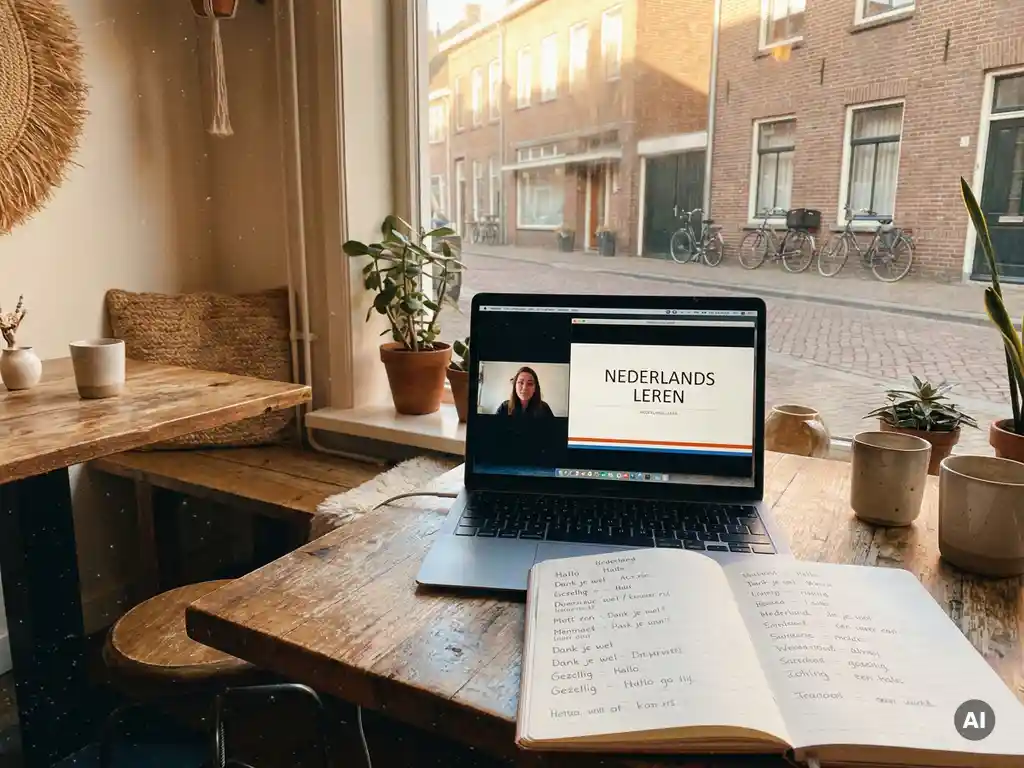
Should you choose Dutch classes in Helmond or an online Dutch course?
If you are based in Helmond and looking for Dutch language courses, an online Dutch course is likely your most practical option in 2026. Helmond itself has limited local provision for structured Dutch classes aimed at expats and internationals, which means commuting to nearby cities or learning online are the two realistic paths. This article walks through the key questions to help you decide which format fits your life best.
Are Dutch classes in Helmond easy to find and access?
Dutch classes specifically designed for expats and highly educated internationals are not widely available in Helmond itself. Most structured language programmes for this audience are concentrated in larger regional hubs like Eindhoven and Tilburg, meaning that finding a quality, communicative Dutch language course in Helmond typically requires either travelling to a nearby city or going online.
For expat partners living in Helmond, the commute to Eindhoven is manageable, around 15 to 20 minutes by train or car, and several well-structured programmes run there in the evenings. However, if your schedule is already packed with family responsibilities, school runs, or part-time work, adding a commute on top of an evening class can make attendance difficult to sustain week after week.
This is why many internationals in the Helmond area start by exploring online options first, and then supplement with in-person classes once they feel more confident or once their routine settles. The local offering in Helmond itself tends to skew toward inburgeringscursussen (civic integration courses), which are structured around a government requirement rather than the practical, conversational focus that most expat partners are looking for.
What are the benefits of taking an online Dutch course instead?
An online Dutch course offers flexibility, consistency, and access to high-quality instruction regardless of where you live. For expats in smaller cities or suburban areas like Helmond, online learning removes the geographical barrier entirely, letting you join structured Dutch language courses with experienced, certified teachers without needing to commute.
Beyond convenience, online Dutch learning brings several genuine advantages:
- Flexible scheduling: You can fit lessons around school pick-ups, part-time work, or your partner’s unpredictable travel schedule.
- Consistent progress: Structured online programmes with e-learning preparation and consolidation activities help you build vocabulary and grammar steadily between sessions.
- Access to better programmes: Online formats give you access to courses designed specifically for highly educated expats, rather than settling for whatever happens to run locally.
- Lower barrier to start: Getting started online is often faster, with no waiting for a local cohort to fill up.
One thing worth noting is that the social dimension of language learning does not have to disappear in an online format. Many online Dutch courses run in small groups, which means you still meet fellow internationals, share experiences, and build friendships, just through a screen rather than a classroom.
How does online Dutch learning compare to in-person classes for speaking practice?
Online Dutch learning can be just as effective as in-person classes for speaking practice, provided the course uses a genuinely communicative format with small groups and live interaction. The key factor is not the delivery method but whether the course prioritises speaking from day one, rather than drilling grammar rules in isolation.
In-person classes have a natural social energy that is hard to replicate fully online. The spontaneous conversations before and after class, the laughter when someone mispronounces something, and the shared experience of navigating a new language together all contribute to motivation and memory. These moments are part of what makes language learning enjoyable and sustainable.
Online classes, on the other hand, can still offer meaningful speaking practice through breakout rooms, pair exercises, and structured conversation activities. Many learners actually find it easier to speak up in an online setting because the slightly reduced social pressure helps them feel less self-conscious about making mistakes.
For expat partners whose primary goal is to have real conversations at the school gate, the doctor’s office, or the local supermarkt, both formats can work. The deciding factor tends to be consistency: whichever format you can attend regularly will produce better results than the theoretically superior option you keep skipping.
Which Dutch course format suits expat partners best?
For expat partners, a blended learning format that combines structured online preparation with live group sessions tends to produce the best results. This approach respects the reality of a busy household schedule while still delivering the speaking practice and social connection that make language learning stick and feel rewarding.
Expat partners often share a specific set of goals: they want to manage daily life independently, feel less isolated, reconnect with their own identity and ambitions, and build a social circle in their new country. A course format that addresses all of these needs, not just the grammar, is worth seeking out.
Small-group classes are particularly well suited to this audience. When you learn alongside eight to ten other internationals who are navigating the same challenges, the classroom becomes more than a language lesson. It becomes a community. You swap tips about local life, laugh about cultural misunderstandings, and leave each session with both new vocabulary and new friendships.
Evening classes also tend to fit the expat partner lifestyle well, especially when they run after the standard working day so that partners who work part-time or who have children at school can attend without disrupting the family routine.
What should you look for in a Dutch course as an expat in the Eindhoven region?
As an expat in the Eindhoven region, the most important things to look for in a Dutch language course are a communicative teaching approach, certified teachers with experience in Dutch as a Second Language, small group sizes, and a curriculum grounded in everyday real-life situations rather than abstract grammar exercises.
Here is a practical checklist when evaluating courses:
- Speaking from day one: Avoid courses that spend weeks on theory before letting you open your mouth. You learn to speak by speaking.
- Certified, specialist teachers: Dutch as a Second Language is a specific discipline. Teachers trained in it understand how adults acquire language and how to build confidence alongside competence.
- Small groups: Classes of eight to ten people give you enough speaking time and enough social variety to make the experience enjoyable.
- Practical content: Look for lessons that prepare you for the situations you actually face: visits to the huisarts, conversations with neighbours, calls to the gemeente.
- Structured progression: A clear path from A0 through to B1, with defined milestones, helps you track your progress and stay motivated.
- Social atmosphere: The best courses feel like a community, not just a classroom. If the school talks about fun, friendship, and cultural discovery alongside grammar, that is a good sign.
Accessibility matters too. Whether you choose an in-person course in Eindhoven or Tilburg, or an online programme, make sure the schedule and location are realistic for your weekly routine. A course you can attend consistently every week will always outperform a more prestigious one you struggle to reach.
How Dutch on Track helps expats in the Eindhoven region learn Dutch
We built Dutch on Track specifically for highly educated internationals and their partners who want to learn Dutch in a practical, social, and genuinely enjoyable way. Our approach combines e-learning preparation, live small-group classes of eight to ten participants, and consolidation activities so that every lesson builds on the last.
- All our teachers are certified specialists in Dutch as a Second Language
- We teach communicatively, which means you speak Dutch from your very first session
- Our classes run in the evenings (17:45 to 19:45) to fit around work and family life
- We offer courses from absolute beginner (A0) all the way to intermediate (B1), including our flagship Dutch in 1 Year programme
- Our locations in Eindhoven and Tilburg are directly accessible by public transport, and we also offer online options
- Beyond language, our courses are a place to make friends, share experiences, and feel at home in the Netherlands
If you are an expat partner in Helmond or the wider Eindhoven region and you are ready to start speaking Dutch with confidence, we would love to hear from you. Schedule a free meeting with us and find out which course fits your level and your life best.
Frequently Asked Questions
I'm a complete beginner with no Dutch at all — is it too late to start, and how quickly can I expect to hold a basic conversation?
It is absolutely not too late to start, and you do not need any prior knowledge to join a beginner course. Most adult learners in a communicative, small-group programme can hold simple everyday conversations — introducing themselves, shopping, asking for directions — within the first few weeks of consistent study. The key is choosing a course that gets you speaking from session one rather than spending months on grammar theory before you ever open your mouth.
What if I miss a class due to family commitments or my partner's travel schedule — will I fall behind?
Missing the occasional class is a reality for most expat partners, and a well-structured course will account for this. Look for programmes that include e-learning preparation and consolidation materials, so you can review what was covered and keep progressing even when life gets in the way. It is also worth asking the school directly how they handle missed sessions — whether recordings are available, whether catch-up support is offered, or whether you can join a different group for that week.
How do I know which level to start at if I have picked up some Dutch informally but never taken a formal course?
Most reputable Dutch language schools offer a short placement assessment — either a written quiz, a brief conversation with a teacher, or both — to help you find the right starting point. If you have been living in the Netherlands for a while and have absorbed some Dutch through daily life, you may be ready for an A1 or A2 group rather than absolute beginner. Being honest about your comfort level with speaking versus reading will help the school place you accurately, so do not just default to the lowest level out of modesty.
Is an online Dutch course suitable for someone who is not particularly tech-savvy or who has never done online learning before?
Yes — most online Dutch courses designed for adult learners are intentionally straightforward to access, typically running through widely used platforms like Zoom or Microsoft Teams that require minimal technical setup. If you can join a video call on your phone or laptop, you have everything you need. A good school will also walk you through the platform before your first session and make sure you feel comfortable before the learning begins.
Should I also use apps like Duolingo alongside a structured Dutch course, or will that cause confusion?
Using apps like Duolingo as a supplement to a structured course can be helpful for building vocabulary and keeping Dutch top of mind between sessions, but they work best as a complement rather than a replacement. Apps tend to focus on isolated words and phrases rather than the communicative, contextual practice you need to actually speak Dutch with confidence. Think of them as a light daily warm-up — useful, but not a substitute for live speaking practice with a qualified teacher.
What is a realistic study time commitment per week if I want to make steady progress?
For most adult learners, a weekly live class of around two hours combined with two to three hours of independent study or e-learning preparation is enough to make consistent, noticeable progress. This does not have to be done in one sitting — fifteen to twenty minutes of daily practice is often more effective than a single long cramming session at the weekend. The most important factor is regularity: showing up every week and engaging with the material between sessions will always outperform sporadic bursts of intense study.
Once I finish a beginner course, what are my realistic next steps for continuing to improve my Dutch?
Completing a beginner course is a significant milestone, and the next step is usually enrolling in the next level (A1 to A2, or A2 to B1) to keep building on your foundation in a structured way. Alongside formal study, start actively using Dutch in your daily life — switch your phone to Dutch, chat with neighbours, listen to Dutch podcasts, or watch Dutch television with subtitles. The transition from classroom Dutch to real-world Dutch can feel daunting at first, but every small interaction outside the classroom accelerates your progress faster than any textbook can.