Which Dutch course in Tilburg is best for working professionals?
The best Dutch course in Tilburg for working professionals is one that fits around a full-time schedule, prioritizes spoken communication over grammar theory, and delivers practical results fast. Evening group classes that combine structured e-learning preparation with interactive classroom practice are widely considered the most effective format for busy professionals. Below, we answer the most common questions professionals ask before enrolling in a Dutch language course in Tilburg.
What makes a Dutch course suitable for working professionals?
A Dutch course is suitable for working professionals when it offers flexible scheduling, a communicative teaching method, and a clear progression structure. The three non-negotiables are evening or weekend class times, small group sizes that maximize speaking practice, and a curriculum anchored in real-life situations rather than abstract grammar rules.
Working professionals rarely have time to sit through passive lectures. What they need is a course that respects their limited hours and makes every minute count. That means lessons should be built around practical scenarios: navigating the workplace, speaking with colleagues, handling appointments, and socializing with neighbors. A communicative approach, where speaking happens from day one, accelerates confidence far faster than a reading-and-writing-heavy syllabus.
Small group sizes also matter enormously. In a group of eight to ten participants, every student gets meaningful speaking time each session. Larger classes dilute that practice, and one-on-one lessons can feel isolating. The sweet spot is a small cohort of fellow internationals who share similar goals and backgrounds, which also creates a natural support network outside the classroom.
What Dutch course options are available in Tilburg?
In Tilburg, Dutch course options for working professionals include evening group classes, private tutoring, online self-study programs, and blended learning courses that combine digital preparation with in-person sessions. Blended learning courses are increasingly popular because they offer the structure of classroom learning with the flexibility of self-paced digital modules.
Language schools and community organizations in Tilburg offer a range of formats. Some focus purely on conversation; others follow a formal curriculum leading to recognized language certificates. For highly educated professionals and expat partners, courses designed specifically for internationals tend to deliver stronger results because the content is calibrated to their existing cognitive skills and daily context in the Netherlands.
In-company training is another option worth considering if your employer supports language development. Some organizations arrange group Dutch lessons on-site, which removes the commute entirely and brings the learning into a familiar professional environment.
How does a blended learning Dutch course work?
A blended learning Dutch course works by combining three phases: digital preparation before class, interactive group practice during class, and digital consolidation afterward. This three-stage cycle ensures that classroom time is spent almost entirely on speaking and listening, while vocabulary and grammar are absorbed through e-learning at the student’s own pace.
Before each session, students complete e-learning modules that introduce new vocabulary, dialogues, and structures. This preparation means that when the group meets, the teacher does not need to explain concepts from scratch. Instead, the session dives straight into practice, role-plays, and real conversations with fellow students.
After class, consolidation exercises reinforce what was practiced. This spaced repetition approach is one of the most evidence-supported methods in language acquisition. The result is that students arrive at each new lesson having retained more from the previous one, which accelerates overall progress significantly compared to traditional classroom-only formats.
What level of Dutch can working professionals realistically reach in one year?
Working professionals who study Dutch consistently for one year can realistically reach B1 level, which is the intermediate level on the Common European Framework of Reference. At B1, you can hold conversations about familiar topics, understand the main points of clear speech, and manage most everyday situations in the Netherlands independently.
Reaching B1 from absolute beginner level in one year requires commitment, but it is achievable with the right structure. A well-designed program covers the journey from A0 to B1 across roughly 43 weeks of regular lessons combined with self-study. This is not a passive process. Students who practice outside the classroom, whether at the supermarket, with neighbors, or during work interactions, progress noticeably faster than those who limit Dutch to lesson time.
For working professionals, B1 is a meaningful milestone. It opens up social conversations, makes professional interactions easier, and significantly reduces the daily friction that comes with living in a country where you do not yet speak the language fluently. Many professionals find that even reaching A2 after a few months brings a dramatic improvement in day-to-day confidence.
Are evening Dutch classes in Tilburg available near the train station?
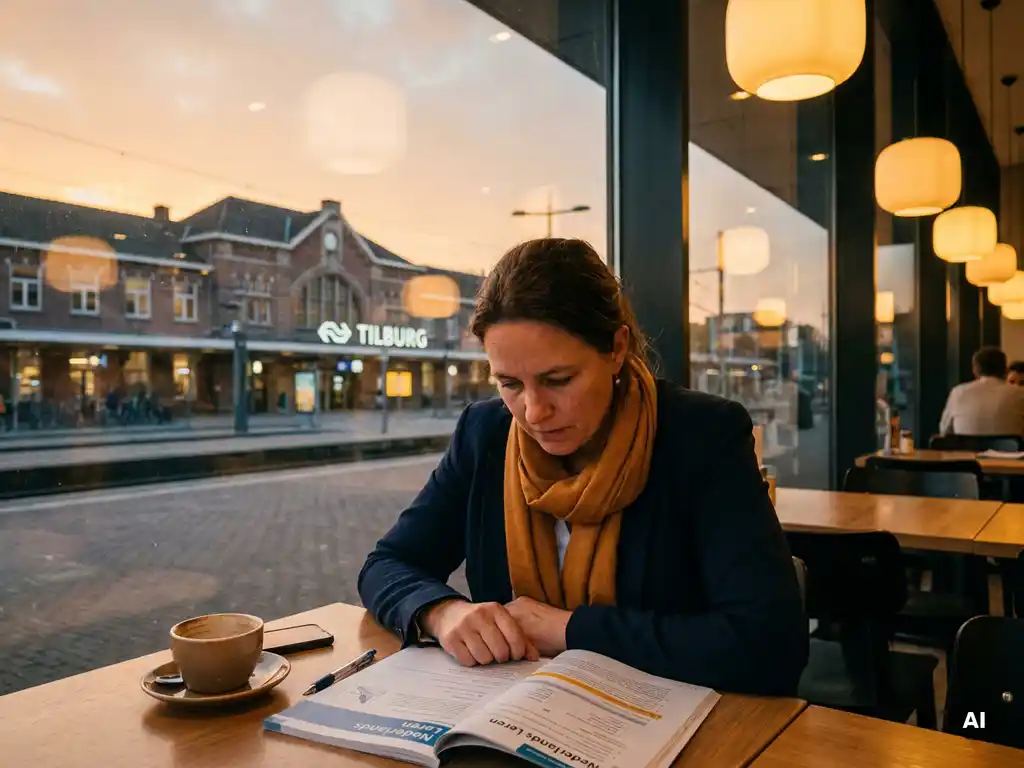
Yes, evening Dutch classes in Tilburg are available near the train station. Several language providers in Tilburg offer after-work classes, typically running from around 17:45 to 19:45, and some are located directly opposite or within walking distance of Tilburg Central Station, making them easy to reach straight from work.
Location matters more than many people realize when choosing a language course. A class that requires a long commute after a full working day quickly becomes a barrier to attendance. A central location, ideally on the route between the office and home, removes that friction and makes it far easier to stay consistent over a full academic year.
Evening timing also suits professionals because it does not require taking time off work or rearranging daytime schedules. The after-work format is designed with the professional lifestyle in mind, and the energy of a group class after the workday can actually be motivating rather than draining, especially when the social atmosphere is warm and the group dynamic is positive.
Should working professionals choose group or private Dutch lessons in Tilburg?
Working professionals in Tilburg should generally choose group Dutch lessons over private tutoring, unless they have highly specific professional language needs or a schedule that makes group attendance impossible. Group classes offer more speaking practice, a richer social dynamic, and the motivational boost of learning alongside people in similar situations.
One of the most underestimated benefits of group learning is the social dimension. Learning Dutch alongside other expats and internationals creates friendships, shared experiences, and a sense of community that private lessons simply cannot replicate. For professionals who are new to Tilburg, this social layer is often just as valuable as the language skills themselves.
Private lessons do have their place. They are ideal for professionals who need to accelerate progress for a specific deadline, focus on a niche vocabulary area, or work around an unpredictable schedule. But for most working professionals, a small group course strikes the best balance between structure, affordability, speaking practice, and the fun of learning with others.
How Dutch on Track supports working professionals in Tilburg
We designed our Dutch language course specifically for highly educated professionals and expat partners who need practical, flexible, and social language learning. Here is what sets our approach apart:
- Blended learning structure: E-learning preparation, interactive evening classes, and consolidation exercises work together so every classroom minute is spent speaking.
- Small groups of 8 to 10 participants: Maximum speaking time and a genuine sense of community with fellow internationals.
- Central Tilburg location: Our classes take place directly opposite Tilburg Central Station, making it easy to attend straight after work.
- Evening schedule: Classes run from 17:45 to 19:45, built around a full working day.
- Certified teachers: All our instructors specialize in Dutch as a Second Language, ensuring professional and encouraging guidance.
- Full progression from A0 to B1: Our flagship “Dutch in 1 Year” program takes you from absolute beginner to independent user in 43 weeks.
- Communicative approach: You speak from day one. We believe confidence comes from practice, not perfection.
If you are a working professional or expat partner in Tilburg ready to start speaking Dutch with confidence, schedule a free meeting with us and we will help you find the right course for your level and goals.
Frequently Asked Questions
How do I know which Dutch level I should start at?
Most language schools in Tilburg offer a free intake assessment — either a short online test or a brief conversation with a teacher — to determine your starting level. If you have had some exposure to Dutch through daily life or a previous course but never studied formally, you likely fall somewhere between A1 and A2, and a good school will place you accordingly rather than defaulting you to a beginner group. Starting at the right level is crucial: too easy and you disengage, too advanced and you lose confidence quickly.
What if I miss a class due to work travel or a busy period?
In a blended learning format, missing an occasional class is manageable because the e-learning modules remain accessible, allowing you to stay on track with vocabulary and structures independently. However, consistent attendance is strongly recommended since the speaking practice that happens in the classroom cannot be fully replicated through self-study alone. If you know in advance that a certain period will be especially demanding at work, discuss it with your teacher early so they can suggest ways to keep your progress on track during that time.
How much time should I realistically set aside for Dutch outside of class each week?
For a blended learning course, plan for roughly two to three hours of self-study per week on top of your evening class — this typically covers the e-learning preparation before each session and the consolidation exercises afterward. Beyond structured study, integrating Dutch into your daily routine makes a significant difference: switching your phone language to Dutch, listening to a Dutch podcast during your commute, or simply attempting small interactions in Dutch at the supermarket all compound over time. The professionals who progress fastest are those who treat Dutch as a daily habit, not just a weekly class.
Can my employer pay for a Dutch course in Tilburg, and is it tax-deductible?
Many employers in the Netherlands are willing to fund Dutch language courses as part of their professional development or integration support budgets, especially for international hires — it is worth raising this directly with your HR department or manager. In some cases, employer-sponsored language training can be provided as a tax-free benefit under the Dutch work-related costs scheme (werkkostenregeling), meaning neither you nor your employer pays tax on it. If your employer does cover the cost, ask your language school whether they can issue a formal invoice and course description to support the reimbursement process.
Is Dutch really that difficult for English speakers, and how long before I can hold a basic conversation?
Dutch is actually considered one of the easiest languages for native English speakers to learn, given the significant overlap in vocabulary and grammatical structures — the US Foreign Service Institute classifies it as a Category 1 language, typically requiring around 600 hours to reach professional working proficiency. For basic conversational ability, most motivated learners can hold simple, practical conversations after just two to three months of consistent study in a communicative course. The key is prioritizing spoken practice from the very first lesson rather than waiting until your grammar feels perfect.
What is the difference between integration Dutch (inburgering) and a professional Dutch course — do I need both?
Integration Dutch (inburgering) is a government-mandated program for certain non-EU residents that focuses on civic knowledge and basic language skills required for the official civic integration exam. A professional Dutch course, by contrast, is designed to build practical, fluent communication skills for daily and professional life, often going well beyond what inburgering covers. If you are required to complete inburgering, a quality professional course will typically prepare you for that exam as a byproduct while also taking your Dutch much further — so in most cases, you do not need both separately.
What should I look for when comparing Dutch language schools in Tilburg to make sure I choose the right one?
The most important factors to compare are teaching methodology (communicative and speaking-focused versus grammar-heavy), class size (aim for ten or fewer participants), scheduling flexibility, teacher qualifications in Dutch as a Second Language, and the profile of other students in the group. Transparency is also a good signal: a reputable school will offer a free intake or trial session so you can experience the teaching style before committing. Be cautious of courses that promise fluency unrealistically fast or that rely heavily on translation rather than immersive Dutch-from-day-one instruction.