What is King’s Day and how do the Dutch celebrate it?
If you are living in the Netherlands as an expat, you will quickly discover that no event captures the Dutch spirit quite like King’s Day. Streets turn orange, music fills every corner, and the entire country seems to step outside at once. Understanding this celebration is one of the best entry points into Dutch culture, and it can genuinely transform how you experience expat life in the Netherlands.
Whether you arrived last month or last year, King’s Day is the kind of event that makes settling in the Netherlands feel a little easier and a lot more fun. This guide answers the most common questions internationals have about the holiday, so you can join in with confidence.
What is King’s Day and why is it so important in the Netherlands?
King’s Day (Koningsdag) is the Dutch national holiday celebrating the birthday of the reigning monarch. Held every year on April 27, it is the single biggest street party in the Netherlands, bringing millions of people together in cities, towns, and villages across the country. For the Dutch, it is far more than a public holiday—it is a shared moment of national identity.
The day carries real emotional weight because it combines national pride with genuine community fun. Unlike formal state ceremonies in other countries, King’s Day belongs to ordinary people. Neighborhoods organize their own parties, families set up stalls on the street, and strangers share snacks and conversation. For anyone who is new to the country, witnessing this collective joy is one of the most memorable experiences of expat life in the Netherlands.
How did King’s Day become a Dutch tradition?
King’s Day has its roots in Queen’s Day (Koninginnedag), a tradition that began in 1885 to celebrate the birthday of Princess Wilhelmina. For over a century, the holiday was held on different dates depending on which queen was reigning. When King Willem-Alexander took the throne in 2013, the date shifted to his birthday, April 27, and the celebration was renamed King’s Day.
The outdoor flea market tradition, known as the vrijmarkt, or free market, grew organically over decades. Citizens discovered they could sell second-hand goods on the street without a permit on this one day of the year, and the practice became a beloved ritual. This grassroots, permission-free spirit reflects something deeply Dutch: a culture that values practicality, equality, and community participation over ceremony and formality.
What do the Dutch actually do on King’s Day?
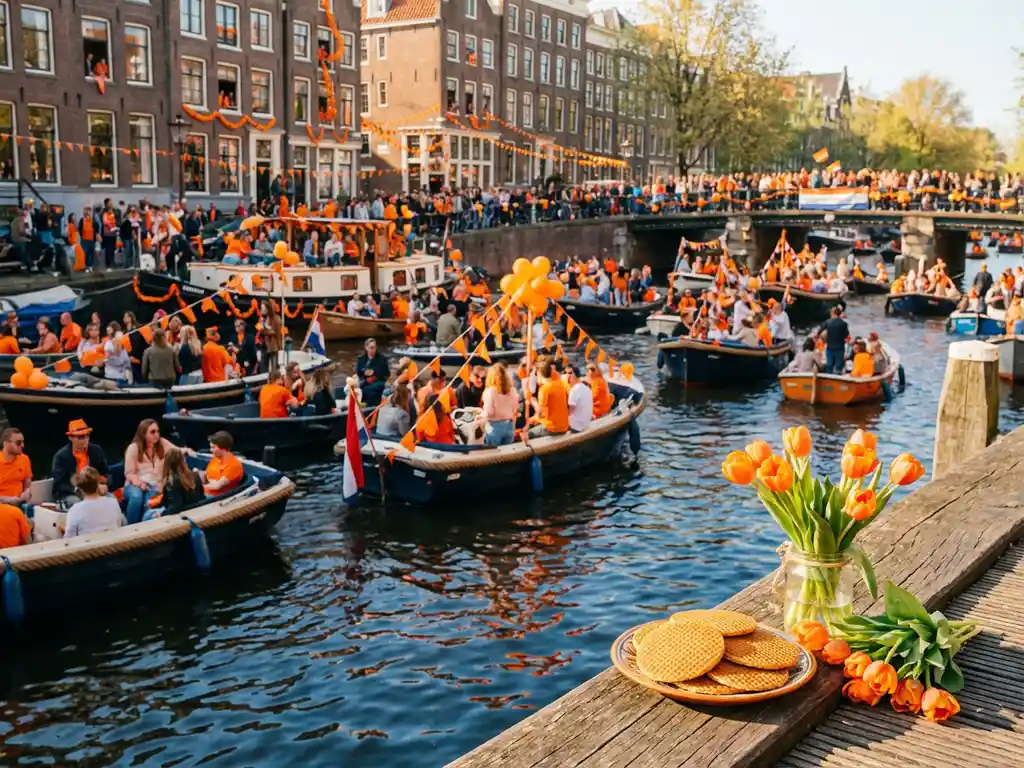
On King’s Day, the Dutch take to the streets in orange clothing, set up flea market stalls, attend live music performances, join boat parades on canals, and gather in parks and public squares. The vrijmarkt is central to the day, where children and adults alike sell old toys, books, clothes, and homemade goods along every pavement.
Cities like Amsterdam, Utrecht, and Eindhoven host enormous outdoor festivals with multiple stages and DJs. In smaller towns, the celebrations are more intimate but equally enthusiastic. Canal cities are especially spectacular, with decorated boats creating floating street parties. For those who are still settling in the Netherlands, joining a local vrijmarkt as either a buyer or a seller is one of the easiest and most natural ways to connect with Dutch neighbors.
- Browse or set up a stall at the vrijmarkt (free market) in your neighborhood
- Join a canal boat party if you are in a city with waterways
- Attend a live music stage in a central square or park
- Wear orange and simply walk through the streets to soak up the atmosphere
Why does everyone wear orange on King’s Day?
Everyone wears orange on King’s Day because orange is the color of the Dutch royal House of Orange-Nassau. The tradition of wearing orange to show national pride and loyalty to the royal family has been part of Dutch culture for centuries, and King’s Day is the most visible expression of this identity.
What makes the orange tradition charming is how playfully the Dutch embrace it. You will see people in full orange outfits, orange wigs, orange face paint, and orange accessories of every kind. There is nothing stiff or obligatory about it—it is an invitation to be a little silly together. For expats and internationals, wearing something orange is an instant social connector. It signals that you are part of the celebration, and Dutch people genuinely appreciate the gesture.
How can expats and internationals join King’s Day celebrations?
Expats and internationals can join King’s Day celebrations simply by showing up in orange and exploring their local neighborhood. No invitation is needed. The vrijmarkt, street parties, and outdoor concerts are open to everyone, and the relaxed, festive atmosphere makes it easy to strike up conversations with people you have never met before.
King’s Day is genuinely one of the most welcoming days in the Dutch social calendar for newcomers. The Dutch are notoriously reserved in daily life, but on this day, social barriers come down noticeably. Bring some cash for the vrijmarkt, grab a stroopwafel or a beer from a street stall, and let the day unfold naturally. If you want to go deeper into the experience, learning a few Dutch phrases beforehand makes a real difference. Even a simple “Gefeliciteerd!” (congratulations) or “Wat kost dit?” (how much does this cost?) at a market stall will earn you a warm smile.
This is also where language learning becomes genuinely social and fun. Being able to chat, even briefly, with a neighbor at a stall or a stranger at a music stage turns a spectator experience into a real connection.
What cultural values does King’s Day reveal about the Dutch?
King’s Day reveals several core Dutch values: egalitarianism, directness, practicality, and a strong sense of community. The vrijmarkt tradition, where a child selling old toys stands next to an adult clearing out their attic, reflects the Dutch belief that everyone participates on equal terms. There is no VIP section at a Dutch street party.
The celebration also shows how the Dutch balance national pride with informality. They are proud of their royal family and their heritage, but they express it through a neighborhood flea market and a beer in the sun rather than a formal parade. For expats who sometimes find Dutch directness or social reserve confusing, King’s Day offers a valuable window into why Dutch culture works the way it does. It is organized by the people, for the people, with minimal fuss.
Understanding these values helps enormously with settling in the Netherlands. When you see that Dutch directness comes from a place of respect and equality rather than rudeness, daily interactions start to make much more sense.
How Dutch on Track helps you feel at home in the Netherlands
Understanding King’s Day is a great start, but truly feeling at home in the Netherlands means being able to communicate, connect, and participate in everyday Dutch life. That is exactly what we help with at Dutch on Track. Our Dutch language courses are designed specifically for expats, highly educated internationals, and their partners in Eindhoven and Tilburg.
Our approach goes beyond grammar drills. We focus on the kind of practical, confident communication that lets you actually use Dutch in real situations—at the vrijmarkt, with your neighbors, at work, or at a King’s Day street party. Our small group classes of 8 to 10 students also mean you build genuine friendships with fellow internationals who are on the same journey as you. It is one of the easiest and most enjoyable ways to build a social network while learning something genuinely useful.
- Blended learning that combines online preparation with interactive classroom practice
- Small groups of 8 to 10 students for a fun, social learning environment
- Certified teachers specialized in Dutch as a Second Language
- Courses from absolute beginner (A0) to intermediate (B1), including our 43-week “Dutch in 1 Year” program
If you are ready to move from watching Dutch life to participating in it, we would love to help. Schedule a free meeting with Dutch on Track to find out which course suits you best, or explore our Beginner Dutch Course if you are just starting out. King’s Day comes around every year, and next time you could be the one chatting with locals in Dutch.
Frequently Asked Questions
When should I start preparing for King's Day as a first-timer?
Ideally, start preparing about a week in advance. Source your orange outfit or accessories early, as shops sell out quickly in the days leading up to April 27. If you plan to set up a vrijmarkt stall, scout your neighborhood for a good spot and gather your items beforehand, since popular locations fill up fast on the morning of the event.
What if King's Day falls on a Sunday — does the date change?
Yes, when April 27 falls on a Sunday, King’s Day is moved to Saturday, April 26, instead. This is worth checking each year before you make plans, especially if you are booking travel or coordinating with friends. A quick search for the current year’s date will confirm whether the celebration shifts.
Are there any King's Day etiquette rules or unwritten social norms I should be aware of?
A few unwritten rules go a long way: respect the vrijmarkt stalls by not lowballing sellers too aggressively (gentle haggling is fine and even expected), keep the streets and canals tidy by using bins where available, and be mindful of noise levels in residential areas late in the evening. Most importantly, embrace the spirit of the day — the Dutch appreciate genuine participation far more than perfect behavior.
Is King's Day family-friendly, or is it mainly a party for adults?
King’s Day is genuinely one of the most family-friendly national holidays in Europe. Children are central to the vrijmarkt tradition, often setting up their own small stalls to sell toys and games, and many neighborhoods organize dedicated kids’ activities, games, and performances throughout the day. That said, city centers like Amsterdam do get very crowded and festive in the evening, so families with young children may prefer to celebrate in their local neighborhood or a smaller town.
What are some common mistakes expats make on their first King's Day?
The most common mistake is underestimating the crowds — especially in Amsterdam, where public transport becomes extremely limited and streets are packed by mid-morning. Plan to walk or cycle, carry cash since many street stalls do not accept cards, and avoid bringing a large bag that is hard to manage in tight spaces. Another missed opportunity is staying only in the tourist areas; exploring your own neighborhood’s vrijmarkt often leads to the most authentic and memorable experiences.
How can learning Dutch before King's Day actually improve my experience?
Even a handful of basic Dutch phrases can transform King’s Day from a passive spectacle into a real social experience. Simple expressions like ‘Wat kost dit?’ (how much is this?), ‘Gefeliciteerd!’ (congratulations!), or ‘Lekker feestje!’ (great party!) open doors to genuine conversations with Dutch neighbors and strangers. The Dutch are particularly warm toward anyone who makes the effort to speak their language, and King’s Day — with its relaxed, open atmosphere — is the perfect low-pressure environment to practice.
Does King's Day happen everywhere in the Netherlands, or is it mainly a big-city event?
King’s Day is celebrated across the entire country, from the largest cities to the smallest villages. While Amsterdam, Utrecht, and Rotterdam host the biggest and most well-known events, smaller cities like Eindhoven, Tilburg, and Haarlem offer vibrant celebrations that are often easier to navigate and more community-focused. If you live outside a major city, your local town center is very likely to have its own vrijmarkt, live music, and street festivities worth exploring.